While deployed to Syria in 2023, U.S. Army Master Sgt. Earlie Brown served as a construction engineer supervisor for infrastructure development projects in the Middle East—a job where vision played a crucial role.
“I was in charge of 30 people, going over blueprints and diagrams, building a landing pad that can land six helicopters and two walls in the middle of them,” he recalled. “So, if drones and bombs were coming in, it couldn’t destroy a whole fleet of helicopters.”
Being deployed near enemy lines, his eyes were more than just a part of construction work–they were critical to the mission.
“You need to try to understand who your enemy is, to understand the direction in which an attack is coming, to be aware of your surroundings, and to be able to shoot down your target that's 300 meters away,” Brown said.
Working in an austere environment, dealing with lots of sand, debris and dust, he knew the importance of wearing protective eyewear and “would always cover my eyes with protection when my guys were out in the field working.”
Yet the job site had other dangers. “In our facility, we had bad water out there because of the waters from the rivers, and that's what we were taking showers with. I think it was a combination between the water and a lot of dust that got in my eyes.”
The pain in Brown’s eyes intensified over time, so much that even looking at dim light was agony.
“I went out to take a shower at nighttime. With just a little bit of light that I encountered, it hurt my eyes so bad,” he said. “I was trying to heal myself with eye drops, and I told the doctor, ‘I'm fine. Just let me keep going on with my mission.’”
Despite the eye pain, Brown tried to push through. “For about a week, I hid in the tent and supervised my guys from there. I'm like, ‘Listen, I'm feeling really bad right now and it’s really hurting my eyes, so I'm going to give you all the directions and instructions for the day and carry out the mission.’”
When he started to lose his vision, Brown went to the military doctor assigned to the base and “asked him to give me some steroid eye drops so I can continue treating myself. I was trying to fight to stay with my guys in Syria, but my eyes weren’t getting any better.” In looking at his red, dry, and swollen eyes, the doctor knew the master sergeant wasn’t fine.
Brown was medically evacuated.
Military Health System Saves His Sight
“They just came up with the best plan of action: take me out of the theater and take me over to Iraq and get medical treatment. Once I got to Iraq, the symptoms got even worse,” Brown said. “I’ve never felt pain like that in my life. I went down to about 20% of vision … it was scary to think that I might lose my vision and my left eye.”
He learned that with eye health, what’s important is what lies beneath.
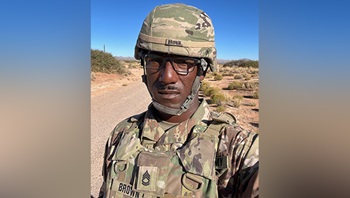 U.S. Army Master Sgt. Earlie Brown while deployed in the Middle East. He suffered from a debilitating eye injury while working as a construction supervisor in Syria. He tried to push through the pain but sought help from the military doctor on base when he started to lose his vision. What followed was an immediate medical evaluation and comprehensive care that helped him regain 90% of sight in his injured left eye.
Even though the doctors told him they could see the damage in the back of his eye, he was still in a deployed hospital with limited resources. Brown was facing another prognosis: orders to go home to be treated properly.
Brown fondly looked back on the effort to get him home. A medevac unit -- call sign Dust Off -- flying back from a deployment stopped in Iraq because they knew they had to “get this guy back to America, ASAP,” he said. “And I remember them doing that for me … in my treatment, I've seen a lot of people going out of their way and just making me a priority and I know they have my back, and they have my best intentions with my health.”
He was flown first to Landstuhl Regional Medical Center and then to Walter Reed National Military Medical Center, where he saw ophthalmologists and optometrists, was put on steroid therapies, and treated for uveitis, a condition where the middle layer of the eye becomes inflamed.
Seeking Help, Setting Sights on the Games
After three months of comprehensive treatment, Brown regained 90% of sight in his injured left eye thanks to the care of his Military Health System team.
“A lot of times when we go through stuff we deal with, we push through, but this was the type of pain that I needed medical care and help with,” Brown said. “The people who treated me care for you like you're one of their children.”
Yet he struggled with being “away from the fight” and his responsibility to his platoon. While his sight was back, he was finding it hard to navigate life—until he reached out for mental health support at the hospital. There, he said, he “found his compass.”
“The mental health professionals are your counselors and without that compass, there's a good chance that you might get lost. So, use your tools,” he said.
He also sought out the U.S. Army’s Soldier Recovery Unit, where he found a new purpose, a new mission: working on himself.
“It's always our job to take care of the people and to make sure the mission is straight. But now, the No. 1 mission is just self-healing, self-awareness, and self-improvement.”
While he still served, the SRU brought him many opportunities to plan for his next steps after retiring. “They put me on with a mentorship program, helped me get back into college with Veteran Readiness and Employment, which is an amazing program … I'm working on my degree in business management, so I might be able to get an office job. I’m now able to do what most soldiers do—find a way to stay in a fight. Just because we’re dealing with something doesn’t mean that we're defeated.”
Through the SRU’s adaptive sports program, Brown found a new vision for his future: athlete for Team Army in the 2025 Department of Defense Warrior Games.
He’s competing in wheelchair basketball, wheelchair rugby, sitting volleyball, and swimming.
To him, it’s not just a sports competition. “All opportunities that can come from it, the support that you get from it, and traveling that you get to do—being a part of it gives you the ability to bond with a whole lot of other soldiers, and everybody's going through something, whether it's mentally or physically.”
As he heads into the competition in July 2025, Brown will have eyes on the finish line, with his family—who have a legacy of military service—by his side.
“When my brothers joined, I had seen them becoming men and that inspired me. My main purpose was to turn me into what they were. Something I could be proud of,” said Brown who has served in the U.S. Army for 24 years. “And my mom, she's just very supportive and she's very proud that she gets to be here for me.”