Surveillance Snapshot: Lengths of Hospital Stays for Service Members Diagnosed with Sepsis, Active Component, U.S. Armed Forces, 2011–2020

Image of Cover 4. The (left to right) Senior Airman Austin Shrewsbury, 88th Diagnostics and Therapeutic Squadron medical laboratory technician, works with student, Airman 1st Class Taylor Altman, 88th Diagnostics and Therapeutic Squadron medical laboratory technician, to identify bacteria of patient’s cultures inside the microbiology laboratory at Wright-Patterson Air Force Base medical center June 30, 2017.

Sepsis is a serious and life-threatening organ dysfunction caused by a dysregulated host response to infection.1 In the U.S., sepsis is a leading cause of in-hospital mortality2 and one of the most expensive conditions treated in U.S. hospitals.3

A 2018 retrospective analysis of more than 2 million U.S. sepsis hospitalizations reported that the median length of stay (LOS) for sepsis increased with disease severity ranging from 7.7 days, 10 days, and 12.6 days for sepsis, severe sepsis and septic shock, respectively.4

A recent MSMR analysis by Snitchler et al. summarized sepsis hospitalizations diagnosed in active component military members between 2011 and 2020.5 During the 10-year surveillance period, crude overall incidence was 39.8 hospitalizations per 100,000 person-years. Annual incidence rates of sepsis hospitalizations increased 64% from 2011 through 2019, then dropped considerably in 2020.5

This snapshot summarizes median LOS metrics for sepsis hospitalizations by year during the same surveillance period (Figure). The median LOS for sepsis was 5 days for the period from 2011 through 2017 and declined to 4 days for the years 2018 and 2019. In 2020, the median LOS increased back to 5 days.

Disclaimer: The content of this manuscript is the sole responsibility of the authors and does not necessarily reflect the views, opinions, or policies of the Uniformed Services University of the Health Sciences, the Department of the Navy, the Department of Defense, or the United States Government. Mention of trade names, commercial products, or organizations does not imply endorsement by the United States Government.

References

  1. Singer M, Deutschman CS, Seymour CW, et al. The Third International Consensus Definitions for Sepsis and Septic Shock (Sepsis-3). JAMA. 2016;315(8):801–810.
  2. Liu V, Escobar GJ, Greene JD. Hospital deaths in patients with sepsis from 2 independent cohorts. JAMA. 2014;312:90–92
  3. Torio CM, Moore BJ. National inpatient hospital costs: the most expensive conditions by payer, 2013. May, 2016. Accessed 1 Nov 2021. https://www.hcup-us.ahrq.gov/reports/statbriefs/sb204-Most-Expensive-Hospital-Conditions.pdf
  4. Paoli CJ, Reynolds MA, Sinha M, Gitlin M, Crouser E. Epidemiology and costs of sepsis in the United States-An analysis based on timing of diagnosis and severity level. Crit Care Med. 2018;46(12):1889–1897.
  5. Snitchler CL, Patel DM, Stahlman SL, Chauhan AV, Wells NY, McQuistan, AA. Sepsis hospitalizations among active component service members, U.S. Armed Forces, 2011–2020. MSMR. 2021;28(11):2–8.
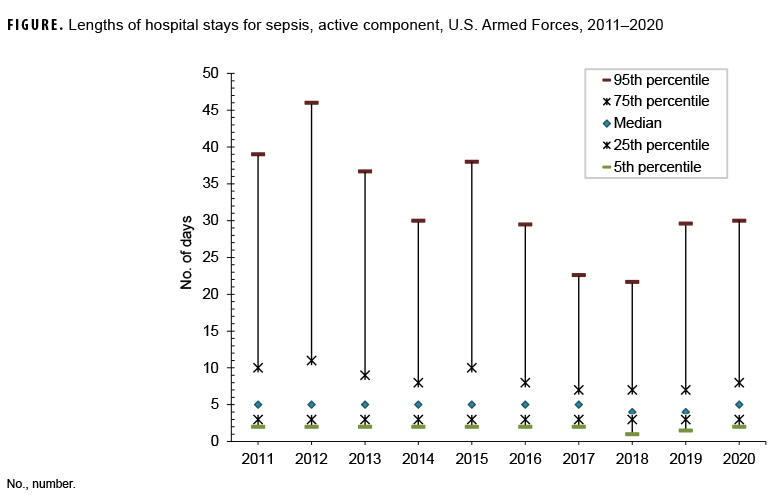
FIGURE. Lengths of hospital stays for sepsis, active component, U.S. Armed Forces, 2011–2020

You also may be interested in...

Topic
Feb 3, 2026

Medical Surveillance Monthly Report

The Medical Surveillance Monthly Report, a peer-reviewed journal launched in 1995, is the Armed Forces Health Surveillance Division's flagship publication. The MSMR provides monthly evidence-based estimates of the incidence, distribution, impact, and trends of health-related conditions among service members.

Report
Dec 1, 2025

MSMR Vol. 32 No. 12 - December 2025

.PDF | 2.90 MB

The December 2025 issue of MSMR features four full reports: the annual update on cold weather injuries among the active and reserve components; a report on trends in the prevalence of obesity among U.S. active component service members and civilians; the annual update on diagnoses of mental health disorders among active component service members; a ...

Article
Dec 1, 2025

Update: Cold weather injuries among the active and reserve components of the U.S. Armed Forces, July 2020–June 2025

Since 2004, MSMR has published annual updates on the incidence of cold weather injuries affecting U.S. Armed Forces members for the five most recent cold seasons. This 2025 report discusses the occurrence of frostbite, immersion hand and foot injuries, hypothermia, as well as “other specified and unspecified effects of reduced temperature.”

Report
Nov 1, 2025

MSMR Vol. 32 No. 11 - November 2025

.PDF | 3.56 MB

The November 2025 MSMR presents four full reports on sexually transmitted infections (STIs), led by the annual update on STIs among active component service members, 2016–2024; followed by a report on follow up testing for chlamydia or gonorrhea among male Air Force basic trainees, 2017–2023; accompanied by a report on sexual networks of service ...

Report
Oct 1, 2025

MSMR Vol. 32 No. 10 - October 2025

.PDF | 2.90 MB

The October 2025 MSMR presents five full reports: measles, mumps, rubella and varicella within the Military Health System; seasonal influenza hospitalization among service members; BMI, physical fitness, and COVID-19 hospitalization in the Army; adverse pregnancy outcomes in female service members after COVID-19 infection or vaccination; long COVID ...

Refine your search