This Surveillance Snapshot describes the mid-year population for active component service members (ACSMs) of the U.S. Army, Navy, Air Force, Marine Corps, Space Force, and Coast Guard from 2023 to 2025, stratified by age, sex, and race and ethnicity. Population counts were obtained from June of each calendar year using personnel data from the Defense Manpower Data Center (DMDC) maintained in the Defense Medical Surveillance System (DMSS). Counts and percentages were stratified by sex, age group, and race and ethnicity.
In DMSS, race and ethnicity are categorized as non-Hispanic White, non-Hispanic Black, Hispanic, Asian/Pacific Islander, and American Indian/Alaskan Native, and Other. Both sex and race and ethnicity are self-reported by individual service members. As of 2021, the values for Asian/Pacific Islander and American Indian/Alaskan Native are not populated in DMSS for the Air Force and Coast Guard, and these 2 groups have been included in the ‘other’ category for this report.
The minimum and maximum mid-year populations of ACSMs ranged from 1,063,862 to 1,085,521 among men and 230,260 to 240,065 among women during the surveillance period. Demographic shifts among ACSMs varied by age and sex. In 2025, 81.8% of the active component was comprised of men, and 18.2% was comprised of women (Table). Stratified by age, the proportion of women was highest among the younger than age 20 years group (21.3%) and lowest in the ages 50-54 years group (15.1%).
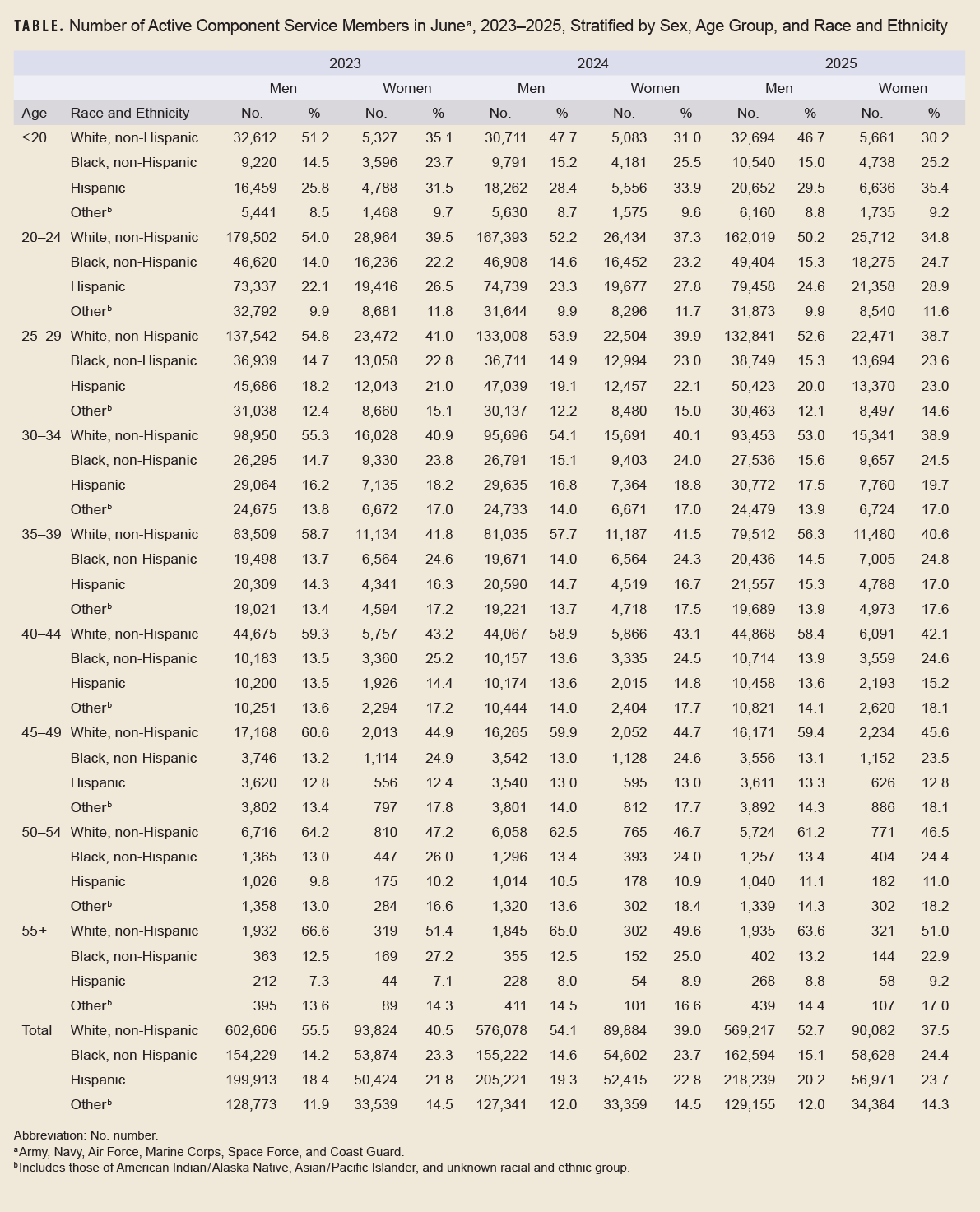
Overall, while non-Hispanic White service members represented the largest proportion by race and ethnicity in 2025, that proportion declined over the surveillance period. The proportion of Hispanic service members increased throughout the surveillance period, continuing a recent trend.1 The greatest demographic shifts are seen in the younger than age 20 years group, with the greatest percent increase in numbers among service members identifying as Black, non-Hispanic, Hispanic, and ‘other’ for both sexes. Among female service members younger than age 20 years, those identifying as Hispanic constituted the largest group (35.4%) in 2025. Similar trends are seen among male service members younger than age 20 years, where non-Hispanic White male service members represented less than half of men in that age group (46.7%), and the proportion of Hispanic men has increased since 2023 (29.5%). Among older age groups, demographic shifts are less pronounced. These data can be used to provide additional context for health surveillance analyses for U.S. ACSMs.
Reference
- McQuistan A, Dreyer E, Mabila S. Mid-year populations by sex, age, and race and ethnicity of active component service members of the U.S. Armed Forces, 2018–2022. MSMR. 2023;30(12):12. Accessed Feb. 26, 2026. https://health.mil/reference-center/reports/2023/12/01/msmr-vol-30-no-12-dec-2023