Annual review of reportable medical events at Military Health System facilities, January 1, 2025–December 31, 2025

Image of MSMR 20265 RMEs. Reportable medical events are a monitored by Military Health System public health officials to monitor, control, and prevent the occurrence and spread of disease.

This month’s edition of the MSMR Reportable Medical Events at Military Health System (MHS) facilities report provides an overview of annual data for 2025 for active component service members (ACSMs) and MHS beneficiaries. Reportable Medical Events (RMEs) are reported in the Disease Reporting System internet (DRSi) by health care providers and public health officials throughout the MHS for monitoring, controlling, and preventing the occurrence and spread of diseases of public health interest. These reports are validated by the Defense Health Agency–Public Health (DHA-PH).
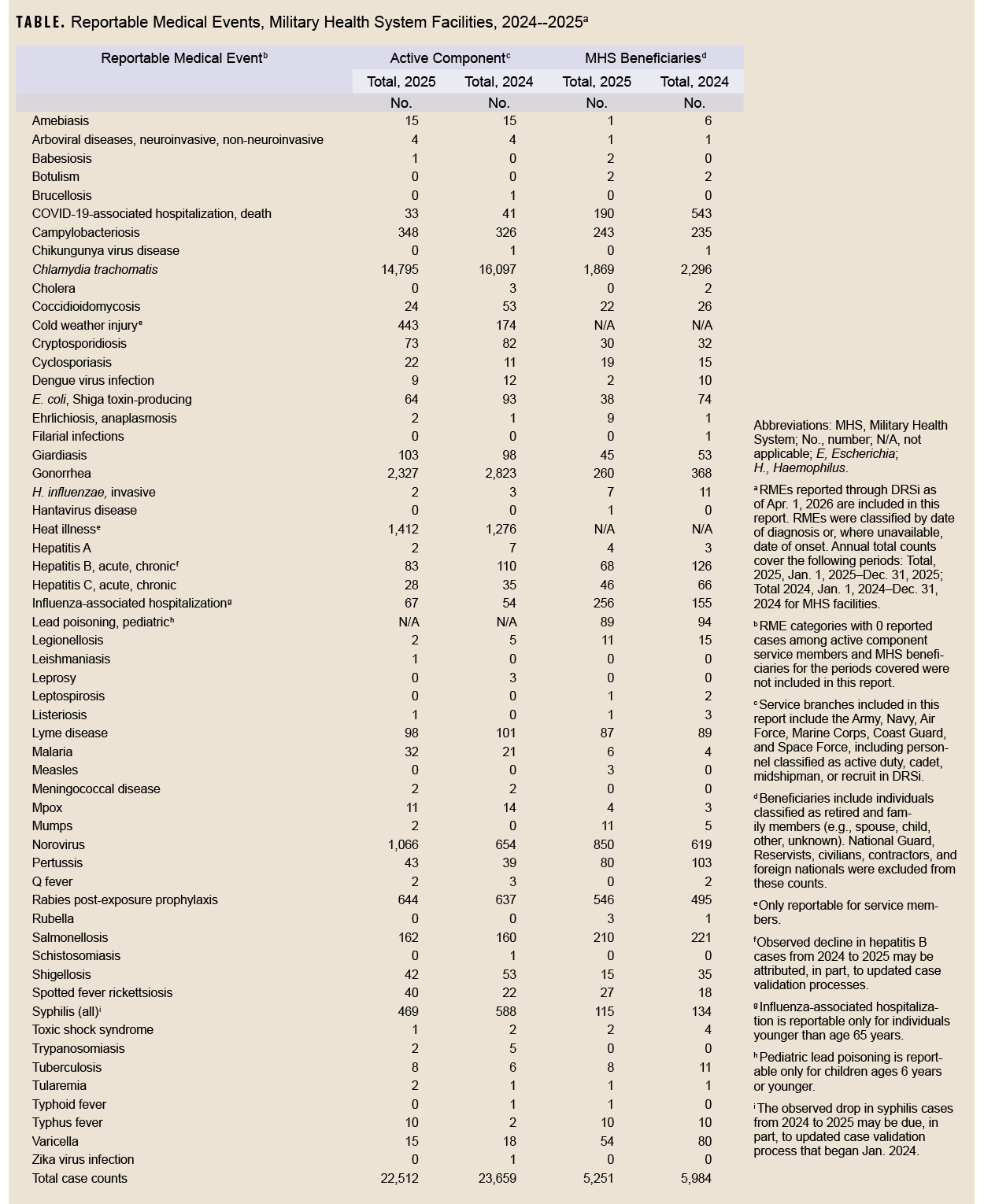
Click on the table to access a Section 508-compliant PDF of this table

The DRSi collects reports on over 70 different RMEs, including infectious and non-infectious conditions, outbreak reports, sexually transmitted infection (STI) risk surveys, and tuberculosis contact investigation reports. A complete list of RMEs is available in the 2022 Armed Forces Reportable Medical Events Guidelines and Case Definitions.1 Data presented in this report are considered provisional and do not represent conclusive evidence until case reports are fully validated.

Top 5 RMEs in 2025, by MMWR Week, for ACSMs and MHS beneficiaries

The top 5 RMEs reported to DRSi in 2025 for ACSMs included chlamydia, gonorrhea, norovirus, heat illness, and syphilis (Figure 1), unchanged from 2024.
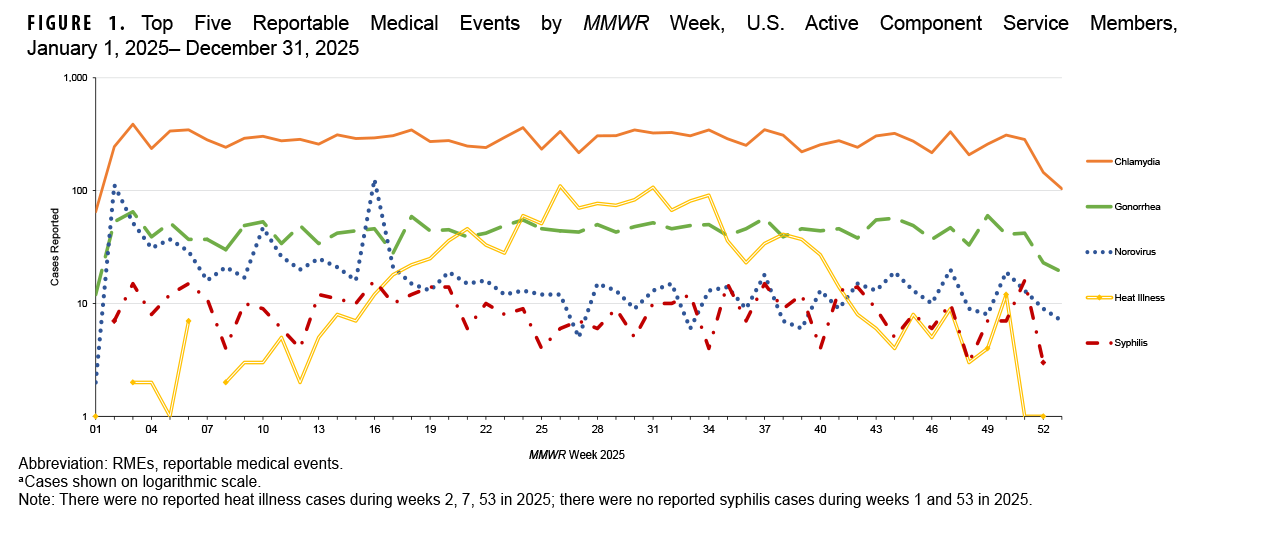
FIGURE 1. Top Five Reportable Medical Events by MMWR Week, U.S. Active Component Service Members, January 1, 2025–December 31, 2025 This line chart, plotted on a logarithmic scale, displays the weekly counts of the top five reportable medical events for active component U.S. Armed Forces members throughout 2025. The purpose of the figure is to show the trends and seasonality of chlamydia, gonorrhea, norovirus, heat illness, and syphilis. Chlamydia was the most frequently reported event, with weekly cases generally ranging between 100 and 1,000. Heat illness shows a distinct seasonal pattern, with virtually no cases in the winter weeks and a sharp peak during the summer months. Norovirus also displays seasonality, with higher counts in the winter and spring. Gonorrhea and syphilis were reported at lower frequencies but consistently throughout the year.

For MHS beneficiaries, the top 5 RMEs reported included chlamydia, norovirus, influenza-associated hospitalization, gonorrhea, and campylobacteriosis (Figure 2), similar to reporting in 2024, with the exception of influenza-associated hospitalization.
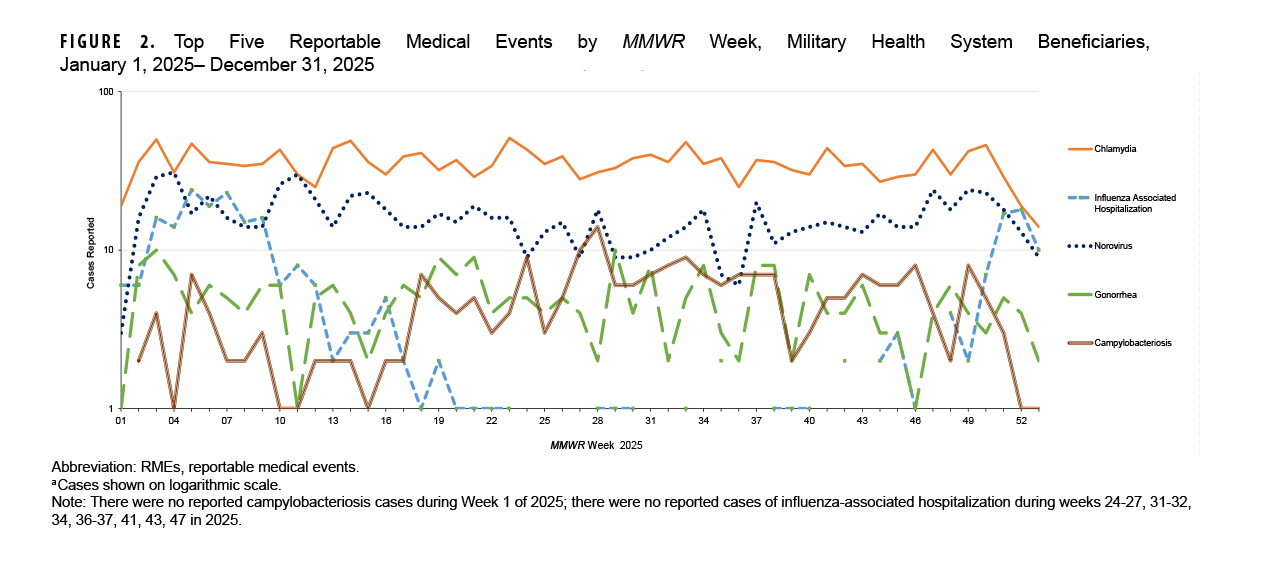
FIGURE 2. Top Five Reportable Medical Events by MMWR Week, Military Health System Beneficiaries, January 1, 2025–December 31, 2025 This line chart, using a logarithmic scale, shows the weekly number of cases for the top five reportable medical events among Military Health System beneficiaries in 2025. The purpose is to illustrate the weekly trends of chlamydia, influenza-associated hospitalization, norovirus, gonorrhea, and campylobacteriosis. Chlamydia is the most reported event. Influenza-associated hospitalizations show a clear seasonal peak in the early and late weeks of the year, corresponding to the winter flu season. Norovirus cases are also more frequent in the winter and spring. Campylobacteriosis and gonorrhea occur at lower levels throughout the year.

Ratios of RMEs for 2025 compared to 2024 for ACSMs and MHS beneficiaries

The current ratio data are based on incidence counts comparing year 2025 to 2024; low numbers for many conditions limit data interpretation and are not included in the figures. Conditions with less than 10 medical event reports (MERs) per year and syphilis were excluded from the ratio comparisons; syphilis and hepatitis B cases were excluded due to changes in case validation processes implemented throughout 2024. Ratios presented in Figure 3 and Figure 4 include any RMEs that had, at minimum, a 30% increase or decrease in MERs in 2025 respective to MERs in 2024.
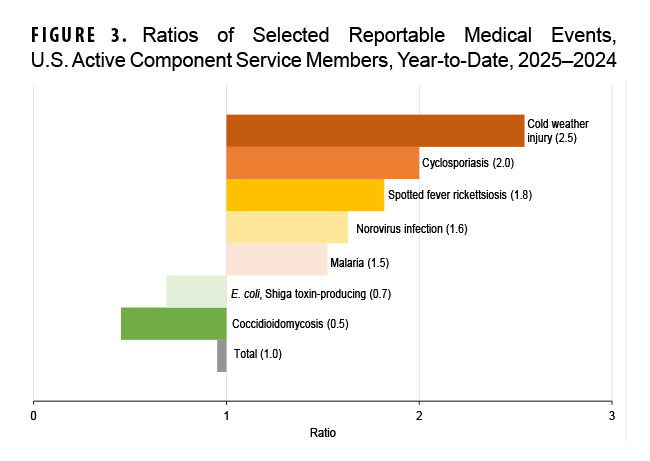
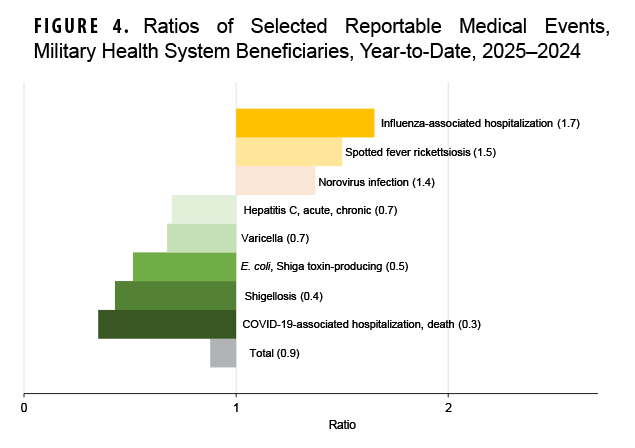
FIGURE 3. Ratios of Selected Reportable Medical Events, U.S. Active Component Service Members, Year-to-Date, 2025-2024 This bar chart displays the ratio of selected reportable medical events in 2025 compared to 2024 for active component U.S. Armed Forces members. The purpose is to show the year-over-year change in the frequency of specific medical events. Cold weather injury showed the largest increase, with a ratio of 2.5, meaning cases more than doubled. Cyclosporiasis, spotted fever rickettsiosis, norovirus infection, and malaria also showed increases, with ratios of 2.0, 1.8, 1.6, and 1.5, respectively. In contrast, E. coli and coccidioidomycosis cases decreased, with ratios of 0.7 and 0.5, respectively. A total ratio of 1.0 indicates no overall change in the selected events combined.FIGURE 4. Ratios of Selected Reportable Medical Events, Military Health System Beneficiaries, Year-to-Date, 2025-2024 This bar chart presents the ratio of selected reportable medical events among Military Health System beneficiaries for 2025 compared to 2024. Its purpose is to highlight significant year-over-year changes in reported medical conditions. Influenza-associated hospitalizations increased by a factor of 1.7. Spotted fever rickettsiosis and norovirus infection also saw increases with ratios of 1.5 and 1.4. Several conditions showed decreases, including hepatitis C (0.7), varicella (0.7), E. coli (0.5), shigellosis (0.4), and COVID-19-associated hospitalization/death (0.3). The total ratio of 0.9 indicates an overall slight decrease in the selected reported events for beneficiaries.

For ACSMs, the total number of MERs submitted to DRSi in 2025 decreased by 4.8% compared to 2024. Cases of cold weather injuries and cyclosporiasis had the most prominent increases in 2025 compared to 2024, with increases of 155% and 100%, respectively. Increases of case counts in 2025 were also recorded for spotted fever rickettsiosis (+82%), norovirus (+63%), and malaria (+52%). There were decreases in 2 RMEs in 2025 versus 2024 for ACSMs: for coccidioidomycosis (-55%) and E. coli, Shiga toxin-producing (-31%) (Figure 3).

For MHS beneficiaries, the total number of MERs submitted to DRSi in 2025 decreased by 12.2% compared to 2024. MHS beneficiaries saw the most prominent increases for cases of influenza-associated hospitalizations and spotted fever rickettsiosis in 2025, with increases of 65% and 50%, respectively. Reports of norovirus also increased among MHS beneficiaries in 2025 versus 2024 (+37%). MHS beneficiaries saw the most significant decrease in cases of COVID-19-associated hospitalization and death (-65%) and shigellosis (-57%) compared to 2024. Decreases were also seen in reports E. coli, Shiga toxin-producing (-49%), varicella (-32%), and hepatitis C, acute and chronic (-30%) (Figure 4).

Discussion

Like the DHA-PH, the U.S. Centers for Disease Control and Prevention (CDC) reported similar trends for the increased influenza-associated hospitalizations in 2025 compared to 2024. The CDC classified the 2024-2025 influenza season as high severity, with the highest estimates of influenza-related illnesses and medical visits since the 2010-2011 influenza season.2 Hospitalization rates were equivalent in 2024-2025 to those during the 2017-2018 season, the last high-severity influenza season.2 Additionally, the CDC reported decreases in COVID-19 hospitalization rates from the 2023-2024 season to the 2024-2025 season, with a similar trend in the MHS.3

For questions about this report, please contact the Disease Epidemiology Branch at the Defense Centers for Public Health–Aberdeen. Email: dha.apg.pub-health-a.mbx.disease-epidemiologyprogram13@health.mil

References

  1. Armed Forces Health Surveillance Division. Armed Forces Reportable Medical Events. Defense Health Agency, U.S. Dept. of War. Accessed Apr. 1, 2026. https://health.mil/reference-center/publications/2022/11/01/armed-forces-reportable-medical-events-guidelines 
  2. U.S. Centers for Disease Control and Prevention. 2024–2025 Influenza Season Summary: Severity, Disease Burden, and Burden Prevented. U.S. Dept. of Health and Human Services. Accessed Apr. 1, 2026. https://www.cdc.gov/flu-burden/php/data-vis-vac/2024-2025-prevented.html 
  3. U.S. Centers for Disease Control and Prevention. Coronavirus Disease 2019 (COVID-19) Hospitalization Surveillance Network (COVID-NET). U.S. Dept. of Health and Human Services. Accessed Apr. 2, 2026. https://www.cdc.gov/covid/php/covid-net/index.html

You also may be interested in...

Topic
June 8, 2026

Medical Surveillance Monthly Report

The Medical Surveillance Monthly Report, a peer-reviewed journal launched in 1995, is the Armed Forces Health Surveillance Division's flagship publication. The MSMR provides monthly evidence-based estimates of the incidence, distribution, impact, and trends of health-related conditions among service members.

Report
May 1, 2026

MSMR Vol. 33 No. 5 - May 2026

.PDF | 2.07 MB

The May 2026 MSMR features four full reports and a brief report, beginning with the annual update of heat exhaustion and heat stroke among U.S. active component service members, 2021–2025; complemented by the annual updates on exertional rhabdomyolysis and exertional hyponatremia among active component service members, 2021–2025; followed by the ...

Report
April 1, 2026

MSMR Vol. 33 No. 4 - April 2026

.PDF | 1.30 MB

The April 2026 MSMR features two full reports and a brief report, beginning with a study of tobacco and nicotine use indicators from two data sources for U.S. active component service members in 2023; followed by a report on head and neck cancer among active component service members from 2010 to 2024; with brief report on the incidence of ...

Report
March 1, 2026

MSMR Vol. 33 No. 3 - March 2026

.PDF | 1.74 MB

The March 2026 MSMR features two full reports and a Surveillance Snapshot, beginning with a report on mortality rates among U.S. service members, from 2010 to 2020; followed by a report on the incidence and burden of endometriosis among U.S. active component service women, 2017 to 2024; with a Surveillance Snapshot on mid-year populations by sex, age, ...

Refine your search