Due to the evolving nature of influenza viruses, the Department of Defense Global Respiratory Pathogen Surveillance Program (DoDGRPSP) conducts worldwide, year-round influenza surveillance of Military Health System (MHS) dependent populations. Specimens collected by DoDGRPSP are submitted to the epidemiology laboratory at the Defense Centers for Public Health–Dayton (DCPHD), Ohio, and the laboratory at Landstuhl Regional Medical Center (LRMC), Germany for analyses that inform test-negative, case-control studies to estimate end of season influenza vaccine effectiveness (VE). Influenza vaccine adjustments are required each year due to antigenic drift and shifts in circulating strains over time. Each influenza season, DoDGRPSP’s VE findings are presented to the U.S. Food and Drug Administration’s advisory committee to help inform strain selection for the next season’s influenza vaccine. This report analyzes end of season influenza VE for MHS dependents against symptomatic, laboratory-confirmed influenza, treated in an outpatient, or ambulatory care, facility.
Methods
During the 2025-2026 influenza season, a total of 1,906 specimens were tested (1,356 by DCPH-D, 550 by LRMC) that provided the data for a test-negative, case-control influenza VE study. Respiratory specimens were collected from MHS dependents who presented at an outpatient, or ambulatory care, clinic with influenza-like illness (ILI). Influenza cases and subtypes were identified using multiplex reverse transcription–polymerase chain reaction (RT-PCR) panels or viral culture; control specimens were ILI patients who tested negative for influenza.
The vaccination statuses of cases in this study were ascertained from either electronic immunization records—namely, MHS GENESIS, MHS Data Repository, MHS Management Analysis and Reporting Tool, and Aeromedical Services Information Management System—or self-reporting through DoDGRPSP patient questionnaires. Individuals were considered vaccinated if they had received the 2025-2026 seasonal influenza vaccine at least 14 days prior to specimen collection. Those who were vaccinated within 14 days of specimen collection were excluded. Additionally, electronic medical records and questionnaires were also utilized to obtain demographic and clinical information including symptomology such as fever, cough, headache, chills, sore throat, runny nose, fatigue, body ache, sinus congestion, dyspnea, loss of taste or smell, diarrhea, vomiting or nausea, and acute respiratory distress. Military service members (due to their generally high influenza vaccination rate), outpatients younger than age 6 months (who are ineligible to receive the vaccine), and the elderly population (age 65 years or older, due to small sample size) were excluded from the VE analysis.
Multivariable logistic regression was used to calculate adjusted odds ratios (aORs), and VE was calculated as 1 minus (-) aOR times (×) 100, adjusting for potential confounding factors, age group (children ages 0-17 years, adults ages 18-64 years), specimen collection month (November–April), and geographic region (Eastern U.S., Western U.S., outside continental U.S.). U.S. Department of Health and Human Services regions 1-5 were grouped to constitute the Eastern U.S. and regions 6-10 were grouped to constitute the Western U.S. VE was estimated against influenza by type and subtype using age-stratified models among dependents. Separate models were developed for all influenza types/subtypes combined, influenza A, influenza B, and influenza A(H3N2). Due to insufficient data, models for influenza A(H1N1) pdm09 could not be stratified by age group. All statistical analyses were performed using SAS version 9.4 (SAS Institute, Inc., Cary, NC).
Results
From November 16, 2025 through April 18, 2026, a total of 561 influenza cases and 1,345 controls were identified in this study, of which 373 (66.5%) cases and 965 (71.7%) controls were vaccinated against influenza. Among vaccinated cases and controls, 60.8% received egg-based vaccines, 13.8% received cell-based vaccines, 1.5% received recombinant vaccines, and 23.9% received an unknown vaccine type, according to electronic immunization records (data not shown). Vaccination rates for cases and controls were 57.4% and 67.0% among adults and 69.5% and 74.8% among children, respectively (Table).
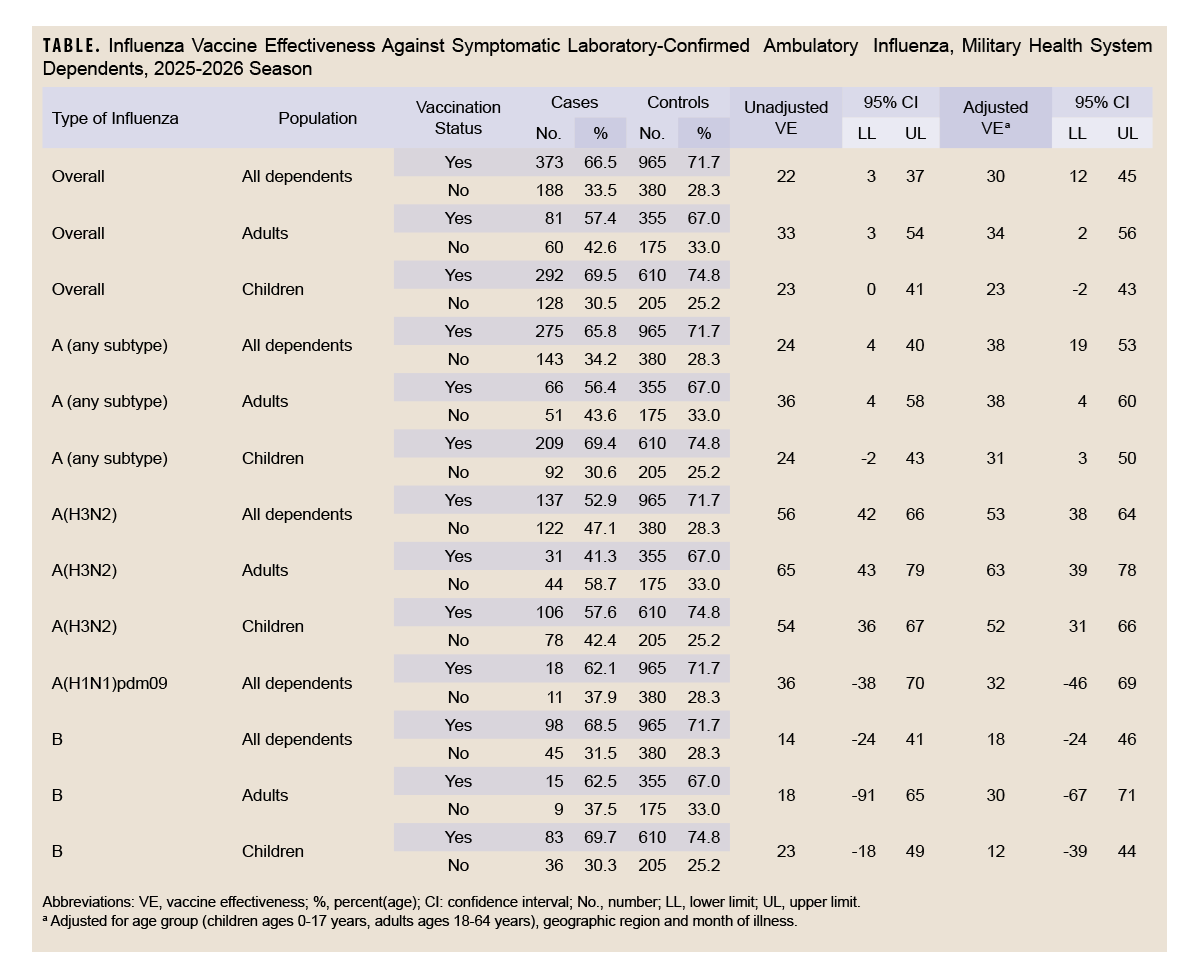
Among all influenza-positive cases, 74.5% (n=418) were influenza A and 25.5% (n=143) were influenza B. Among the cases of influenza A, 62.0% (n=259) were influenza A(H3N2), 31.1% (n=130) were influenza A/not subtyped, and 6.9% (n=29) were influenza A(H1N1)pdm09. After adjustments for age group, month of specimen collection, and geographic region, VE was 30% (95% confidence interval [CI] 12, 45) in all dependents, and 34% (95% CI 2, 56) in adults and 23% (95% CI -2, 43) in children. The VE against influenza A (any subtype) cases (65.8% vaccinated) was 38% (95% CI 19, 53) for all dependents, and 38% (95% CI 4, 60) among adults and 31% (95% CI 3, 50) among children. Among the 259 influenza A(H3N2) cases (52.9% vaccinated), VE was 53% (95% CI 38, 64) for all dependents, 63% (95% CI 39, 78) for adults, and 52% (95% CI 31, 66) for children. Adjusted VE against any influenza type in children and influenza B and A(H1N1)pdm09 among all age dependents were not statistically significant (Table). Statistically significant VE against influenza A (any subtyped) and influenza A(H3N2) was observed among all populations.
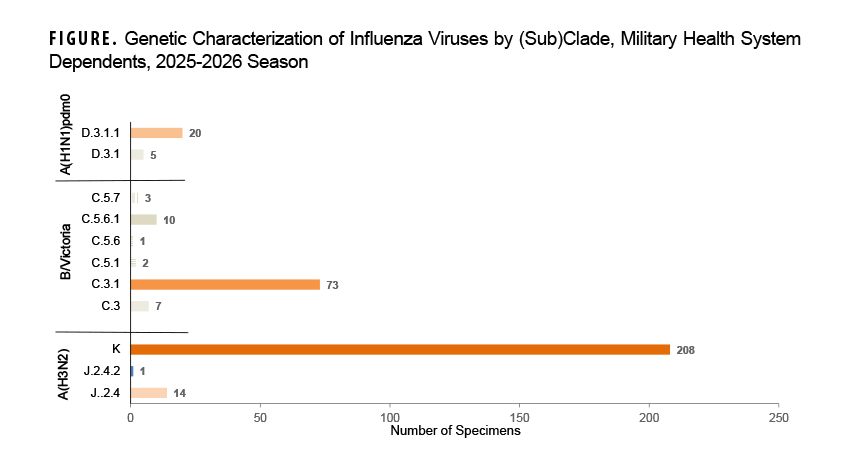 Among the 259 influenza A(H3N2)-positive specimens, 223 were sequenced. Analysis identified 208 specimens as subclade K, while 14 were J.2.4, and 1 was J.2.4.2. Among the 143 influenza B-positive specimens, 96 were sequenced, and 73 were identified as subclade C.3.1, with 10 identified as subclade C.5.6.1, 7 as subclade C.3, 3 as subclade C.5.7, 2 as subclade C.5.1. and 1 as subclade C.5.6. Among the 29 influenza A(H1N1)pdm09-postive specimens, 25 were sequenced, with 20 identified as subclade D.3.1.1 and 5 identified as subclade D.3.1 (Figure).
Discussion
These study findings indicate that seasonal VE during the 2025-2026 influenza season was effective in preventing laboratory-confirmed influenza, especially influenza A(H3N2), for which VE ranged 52–63% among all age groups. The 2025-2026 influenza season revealed predominant circulation of influenza A(H3N2) (subclade K) viruses within DoDGRPSP study samples, similar to the interim results from other studies.1-3 The results of this study suggest that influenza vaccination reduced odds of medical care for influenza infection among the MHS non-service member population by approximately 30%, slightly lower than the 36% and 44% early influenza reports in France and Europe, respectively.3,4
DoDGRPSP analyses suggest low-to-moderate protection against influenza A for all populations including influenza A(H3N2) during the 2025-2026 season. DoDGRPSP estimates of VE against influenza B among all age groups after vaccination were not significant. A possible factor that could explain the ineffectiveness observed for influenza B is that primary analysis did not capture individual continuums, from inoculation to exposure. Vaccination against A(H1N1)pdm09 also did not reach statistical significance, likely due to the low case count. Another potential contributing factor in observed variations in VE across strains could be the temporal relationship between vaccine administration and the peak period of viral circulation. This observation is supported by studies from Australia and the U.S. that indicate VE starts to decline 3–6 months after administration among observed patients.5,6
Seasonal dominance of influenza A(H3N2) viruses is generally associated with lower VE. The moderate VE observed for the 2025-2026 season is not an unexpected result but part of a recurring pattern, particularly in recent influenza seasons, when A(H3N2) predominates. The consistency of these results implies that vaccine strain selection and efficacy prediction methods are functioning as expected. Although estimated VE was moderate, it remained within a predictable range7,8; interim estimates from Canada for this influenza season were for 54% overall VE.9 DoDGRPSP sequencing data indicate that influenza A(H3N2) subclade K drifted antigenically after the 2024-2025 season. Available interim VE estimates from Canada, China, England, and France support this finding.1-3,10
Adjusted VE estimation against influenza A(H3N2) in the DoDGRPSP adult group (63%) was higher than interim reports from Europe, whereas VE against influenza A(H3N2) among children (52%) remained within the range observed in the European studies (51–82%).2,4 These inconsistencies with reported A(H3N2) VE could be associated with age-specific coverage. Early seasonal data from China indicated lower VE (41.3%, 95% CI 29, 51) compared to DoDGRPSP data (53%, 95% CI 38, 64).1 DoDGRPSP estimates of overall adult VE, however, are consistent with the interim report from the Virtual SARS-CoV-2, Influenza, and Other respiratory viruses Network (VISION).11
Estimated VE against influenza A (any subtype) among adults and all dependents was similar to the 38% (95% CI 27, 47) estimate from Canada10; influenza A (any subtype) VE in children was low and statistically significant when compared to estimated VE in Canada.10 Estimates of VE against influenza B for children as well as adults were comparable to the recent US Flu VE network estimates despite overlapping CIs throughout.11 Previous studies had observed high statistical significance for VE against influenza B among MHS beneficiaries.12 This could be at least partially explained by the low levels of influenza B circulation in North America.
The findings in this report are subject to several limitations. First, patients who received 1 dose of the 2025-2026 influenza vaccine were considered vaccinated, but children ages 6 months to 8 years are recommended 2 doses if 1) never vaccinated against influenza, 2) had not received at least 2 vaccine doses prior to July 1, 2025, or 3) vaccination history was unknown.13 Consequently, some children who were classified as vaccinated may not have been fully vaccinated, which could reduce VE estimation accuracy, resulting in non-significant VE among children for influenza overall, influenza A, and influenza B. Second, small sample sizes of cases in varying populations prevented VE estimation for influenza A(H1N1)pdm09 and influenza B in some age groups. Third, although VE can vary by production method, this analysis did not differentiate between the egg- and cell-based influenza vaccines received by the study population. Finally, the wide CIs in both age strata, and particularly the imprecision in the pediatric estimate, reflect limited statistical power for subgroup analysis. Larger studies or pooled multi-season data would be necessary for more definitive conclusions about age-specific VE. Combining data from multiple influenza seasons may permit influenza VE analysis of relationships between VE and several viral and host factors.
DoDGRPSP analyses of virus subtypes after influenza vaccination during the 2025-2026 influenza season revealed moderate viral protection against influenza A(H3N2), the dominant strain among specimens collected for this study. In addition, DoDGRPSP estimates indicate that the 2025-2026 vaccine reduced influenza-associated outpatient health care visits by approximately 30%. Overall, these DoDGRPSP findings support promotion of influenza vaccination in concert with other preventive measures, such as proper handwashing techniques and appropriate social distancing during the infectious period of the illness.
References
- Shen Y, Zhang D, Feng Z, et al. Moderate protection from vaccination against influenza A(H3N2) subclade K in Beijing, China, September to December 2025. Euro Surveill. 2026;31(2):2500993. doi:10.2807/1560-7917.es.2026.31.2.2500993
- Kirsebom FC, Thompson C, Talts T, et al. Early influenza virus characterisation and vaccine effectiveness in England in autumn 2025, a period dominated by influenza A(H3N2) subclade K. Euro Surveill. 2025;30(46):2500854. doi:10.2807/1560-7917.es.2025.30.46.2500854
- De Clercq A, Blanquart F, Vieillefond V, et al. Interim vaccine effectiveness against influenza virus among outpatients, France, October 2025 to January 2026. Euro Surveill. 2026;31(2):2500992. doi:10.2807/1560-7917.es.2026.31.2.2500992
- European Centre for Disease Prevention and Control. Early Estimates of Seasonal Influenza Vaccine Effectiveness Against Influenza Requiring Medical Attention at Primary Care Level in Europe, Week 41-49, 2025. Accessed Feb. 27, 2026. https://www.ecdc.europa.eu/en/news-events/early-estimates-seasonal-influenza-vaccine-effectiveness-against-influenza-requiring
- Mordant FL, Price OH, Rudraraju R, et al. Antibody titres elicited by the 2018 seasonal inactivated influenza vaccine decline by 3 months postvaccination but persist for at least 6 months. Influenza Other Respir Viruses. 2023;17(1):e13072. doi:10.1111/irv.13072
- Hu W, Sjoberg PA, Fries AC, DeMarcus LS, et al. Waning vaccine protection against influenza among Department of Defense adult beneficiaries in the United States, 2016-2017 through 2019-2020 influenza seasons. Vaccines. 2022;10(6):888. https://doi.org/10.3390/vaccines10060888
- Belongia EA, McLean HQ. Influenza vaccine effectiveness: defining the H3N2 problem. Clin Infect Dis. 2019;69(10):1817-1823. doi:10.1093/cid/ciz411
- Frutos AM, Cleary S, Reeves EL, et al, CDC Influenza Vaccine Effectiveness Collaborators. Interim estimates of 2024-2025 seasonal influenza vaccine effectiveness: four vaccine effectiveness networks, United States, October 2024–February 2025. MMWR Morb Mortal Wkly Rep. 2025;74(6):83-90. doi:10.15585/mmwr.mm7406a2
- Separovic L, Zhan Y, Kaweski SE, et al. Interim estimates of vaccine effectiveness against influenza A(H1N1)pdm09 and A(H3N2) during a delayed influenza season, Canada, 2024/25. Euro Surveill. 2025;30(4):2500059. doi:10.2807/1560-7917.es.2025.30.4.2500059
- Separovic L, Sabaiduc S, Zhan Y, et al. Interim 2025/26 influenza vaccine effectiveness estimates with immuno-epidemiological considerations for A(H3N2) subclade K protection, Canada, January 2026. Euro Surveill. 2026;31(5):2600068. doi:10.2807/1560-7917.es.2026.31.5.2600068
- Maloney P, Reeves EL, Wielgosz K, et al. Interim estimates of 2025-26 seasonal influenza vaccine effectiveness–United States, September 2025–February 2026. MMWR Morb Mortal Wkly Rep. 2026;75(9):116-123. doi:10.15585/mmwr.mm7509a2
- Eick-Cost AA, Thervil JW, Hu Z, DeMarcus LS. Mid-season influenza vaccine effectiveness estimates among DOD populations: a composite of data presented at VRBPAC–the Vaccines and Related Biological Products Advisory Committee–2024 meeting on influenza vaccine strain selection for the 2024-2025 influenza season. MSMR. 2024;31(3):20-23. Accessed Mar. 27, 2026. https://www.health.mil/reference-center/reports/2024/03/01/msmr-march-2024-volume-31-number-3
- Grohskopf LA, Blanton LH, Ferdinands JM, et al. Prevention and control of seasonal influenza with vaccines: recommendations of the Advisory Committee on Immunization Practices–United States, 2025-26 influenza season. MMWR Morb Mortal Wkly Rep. 2025;74(32):500-507. doi:10.15585/mmwr.mm7432a2
Author Affiliations
Defense Centers for Public Health–Dayton, Public Health Directorate, Defense Health Agency, Wright-Patterson Air Force Base, Dayton, OH: Mr. Kwaah, Ms. DeMarcus, Dr. Jenkins, Dr. Salter, Ms. Hartless, Dr. Heh, Dr. Fries, Dr. Evengue, Mr. Gruner, Dr. Muehleman; JYG Innovations, LLC, Dayton: Mr. Gruner, Dr. Muehleman; Innovative Element, LLC, Beavercreek, OH: Mr. Kwaah, Ms. DeMarcus, Dr. Jenkins; Dr. Salter, Ms. Hartless, Dr. Heh; U.S. Air Force School of Aerospace Medicine Epidemiology Laboratory, Wright-Patterson Air Force Base: Dr. Fries
Disclaimers
The views expressed in this report reflect the results of research conducted by the authors and do not necessarily reflect official policy nor position of the Defense Health Agency, Department of the Air Force, Department of War, or the U.S. Government.
This study was funded by the Global Emerging Infections Surveillance Branch of the Armed Forces Health Surveillance Division, ProMIS ID P0047 26 US.