Abstract
This report provides an annual surveillance update through 2025 on routine screening results for antibodies to the human immunodeficiency virus (HIV) among members of the U.S. Armed Forces. Approximately 6.1 million active, guard, and reserve component personnel were tested for HIV antibody seropositivity from 2021 through 2025, resulting in 1,365 incident diagnoses and an overall seropositivity rate of 0.22 per 1,000 individuals tested. Incident cases remained concentrated among male service members (97.5%) and individuals under age 35 years (85.3%). In 2025, the highest rate overall was observed in the Army Reserve (0.51 per 1,000 tested), followed by the Navy active component (0.33 per 1,000 tested) and Army National Guard (0.32 per 1,000 tested). The lowest active component rates were documented in the Air Force (0.12 per 1,000 tested) and Coast Guard (0.11 per 1,000 tested). In 2025, 68.7% of active duty soldiers and 77.9% of active duty sailors diagnosed with HIV from 2021 through 2025 remained in military service, demonstrating the impact of updated retention policies.
What are the new findings?
From 2021 through 2025, approximately 6.1 million U.S. service members were screened for HIV, identifying 1,365 new infections, with a stable overall seropositivity rate of 0.22 per 1,000 tested. In 2025, the highest rate was documented in the Army Reserve, at 0.51 per 1,000, while career longevity reached historic levels as updated retention policies preserved a majority of diagnosed service members on active and reserve duty.
What is the impact on readiness and force health protection?
The HIV antibody screening program remains an important element of U.S. military force health protection, particularly for men younger than age 35 years, in all service branches and components. The retention of HIV-positive service members reflects changes in U.S. Department of War policies that allow service members who are asymptomatic and have undetectable viral loads to serve without restrictions.
Background
The U.S. Department of War (DOW) has conducted an active surveillance program for the human immunodeficiency virus (HIV) since 1986. All service members of the active component, National Guard, and reserve component are screened at specific points in time: prior to entry (all accessions must be HIV-negative prior to start of service), before deployment or any change in status (e.g., change in component, between branches, commissioning), and once every 2 years while a member of the U.S. military.1
From 1990 through 2024, more than 46 million tests for HIV antibodies were conducted among members of the U.S. Armed Forces, resulting in identification of 11,280 HIV new diagnoses (24.3 per 100,000 persons tested). As initial control efforts prohibited HIV-positive individuals from military accession or service, rates of HIV diagnoses dropped precipitously during the first decade of screening, but the rate has remained stable for the last 2 decades.2
Infection with HIV remains a disqualifying diagnosis for entry into U.S. military service, but in June 2022, the then-Department of Defense (DOD) amended policies to prevent HIV-positive service members with an undetectable viral load from being discharged or separated solely on the basis of HIV status.1 In addition, HIV-positive personnel are not non-deployable solely for a positive status, as decisions related to deployability are made individually, justified by a service member’s ability to perform assigned duties.3
Summaries of HIV seropositivity for members of the U.S. military have been published in MSMR since 1995. This report summarizes numbers and trends of newly identified HIV-antibody seropositivity from January 1, 2021 through December 31, 2025 among active and reserve component members of 5 services of the U.S. Armed Forces, in addition to the Army and Air Force National Guard.
Methods
The surveillance population included all individuals eligible for HIV antibody screening from January 1, 2021 through December 31, 2025, while serving in the active and reserve components of the U.S. Army, Navy, Air Force, Marine Corps, and Coast Guard; Space Force members were categorized as Air Force personnel for this analysis. Testing records from U.S. military medical testing programs, including records of initial HIV-antibody detection, were identified using Department of War Serum Repository (DOWSR) specimen records accessioned in the Defense Medical Surveillance System (DMSS).
An incident case of HIV-antibody seropositivity was defined as an individual with positive HIV test results on 2 different, serial specimens. Individuals who had just 1 positive result without a subsequent negative result were also defined as positive, to capture those who had yet to test positive a second time. The total number of HIV-positive tests was acquired from DMSS to calculate seropositivity rates as a standardized methodology for all services.
Annual rates of HIV seropositivity among service members were calculated by dividing the number of new incident cases of HIV-antibody seropositivity during each calendar year by the number of individuals tested at least once during the relevant calendar year. Rates were further stratified by branch of service, component, and sex. Overall rates by age category were calculated for all services for the complete annual years 2021 through 2025.
 Results
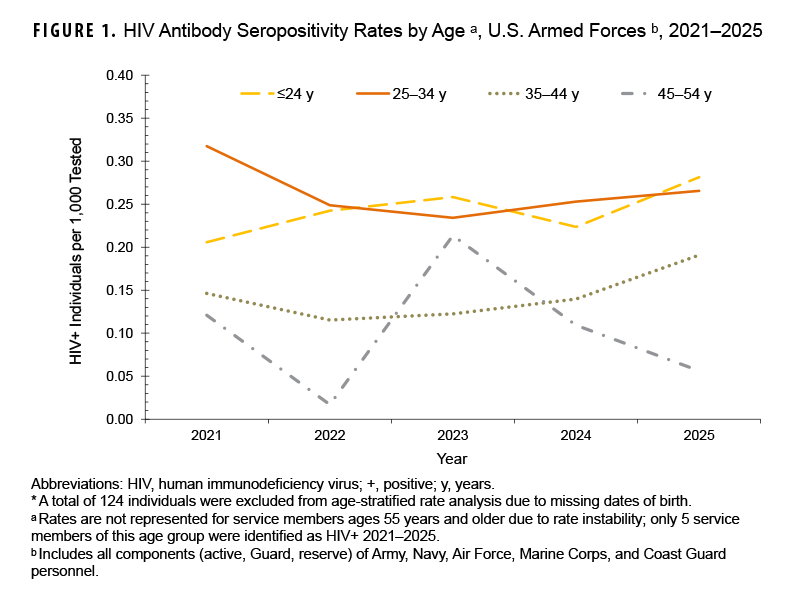
From 2021 through 2025, approximately 6.1 million service members (active component, Guard, reserve) were tested for antibodies to HIV; 1,365 were identified as HIV-antibody-positive (seropositivity 0.22 per 1,000 tested) (data not shown). The male rate (0.27 per 1,000 tested) persisted above the female rate (0.03 per 1,000 tested) throughout the surveillance period, as only 34 women were identified as newly HIV-antibody-positive during that time. Age-specific HIV seropositivity rates are presented for complete annual years in Figure 1. In 2025, the highest HIV seropositivity rate was observed among service members ages 24 years and younger, followed by those ages 25-34 years. This continues a trend seen since 2021, where these 2 age groups have consistently reported the highest rates, often alternating for the leading position. In 2023, the seropositivity rate for service members ages 45-54 years increased to 0.21 per 1,000 tested, corresponding to an increase from 1 HIV seropositive case identified in 2022 to 12 cases in 2023 (data not shown).
U.S. Army, active component
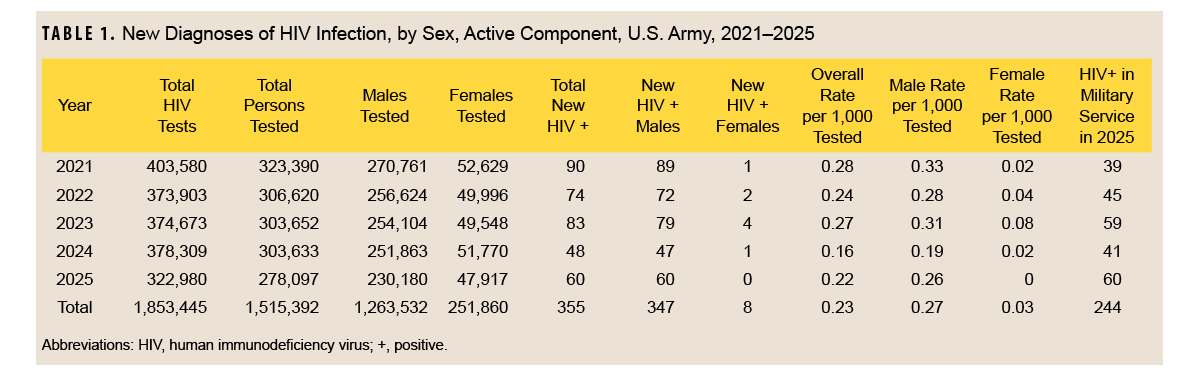
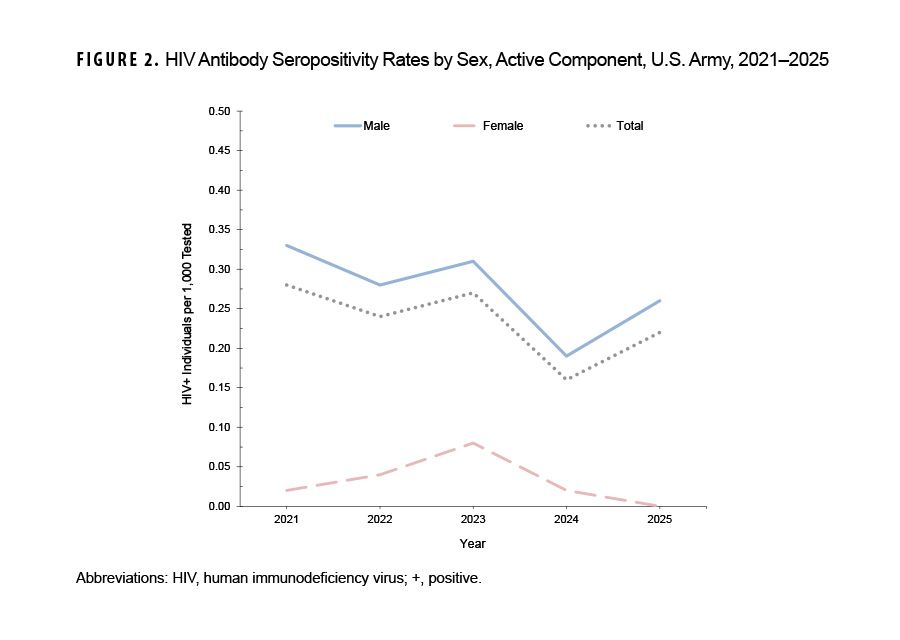
In 2025, a total of 278,097 U.S. Army active component soldiers were tested for HIV antibodies; 60 were identified as HIV-antibody-positive (seropositivity 0.22 per 1,000 tested) (Table 1). During the surveillance period, annual seropositivity rates fluctuated between a low of 0.16 per 1,000 tested in 2024 and a high of 0.28 per 1,000 tested in 2021 (Table 1, Figure 2). Annual seropositivity rates for male active component soldiers were considerably higher than the seropositivity rates of female active component soldiers (Figure 2). On average, 1 new HIV infection was detected per 5,383 screening tests among active component soldiers in 2025 (Table 1). Of the 355 active component soldiers diagnosed with HIV infection since 2021, 244 (68.7%) were still in military service in 2025.
Army National Guard
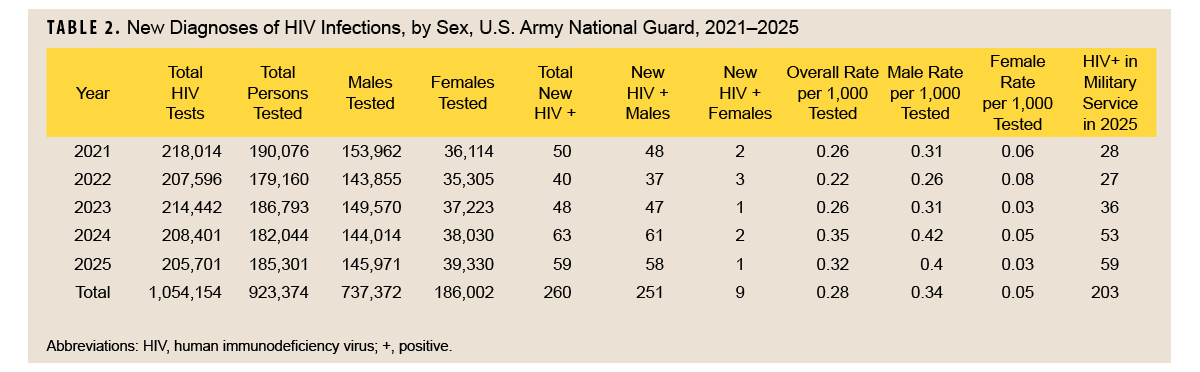
In 2025, a total of 185,301 U.S. Army National Guard members were tested for HIV antibodies; 59 were identified as HIV-antibody-positive (seropositivity 0.32 per 1,000 tested) (Table 2). On average, 1 new HIV infection per 3,486 screening tests was detected among National Guard soldiers in 2025. Of the 260 National Guard soldiers diagnosed with HIV infection since 2021, 203 (78.1%) were still in service in 2025.
Army Reserve
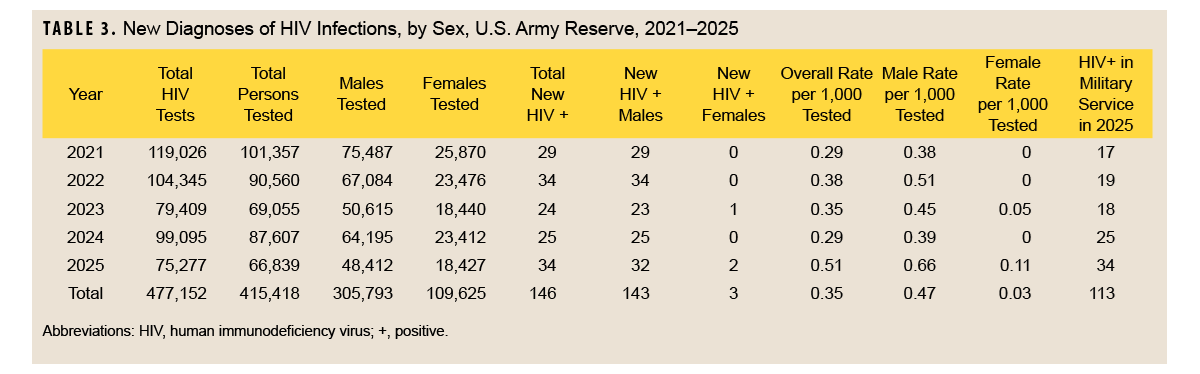
In 2025, a total of 66,839 U.S. Army Reserve members were tested for HIV antibodies; 34 were identified as HIV-antibody-positive (seropositivity 0.51 per 1,000 tested) (Table 3). On average, 1 new HIV infection per 2,214 screening tests was detected among Army reservists in 2025. Of the 146 Army reservists diagnosed with HIV infection since 2021, 113 (77.4%) were still in service in 2025.
U.S. Navy, active component
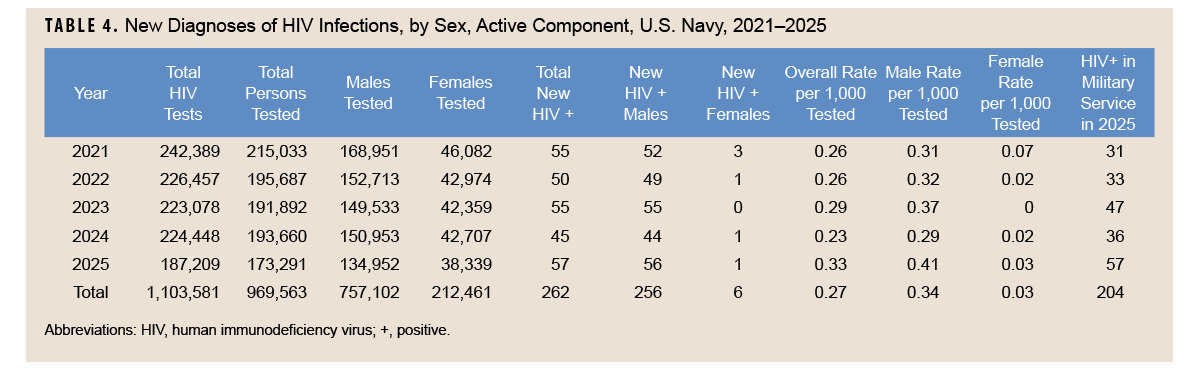
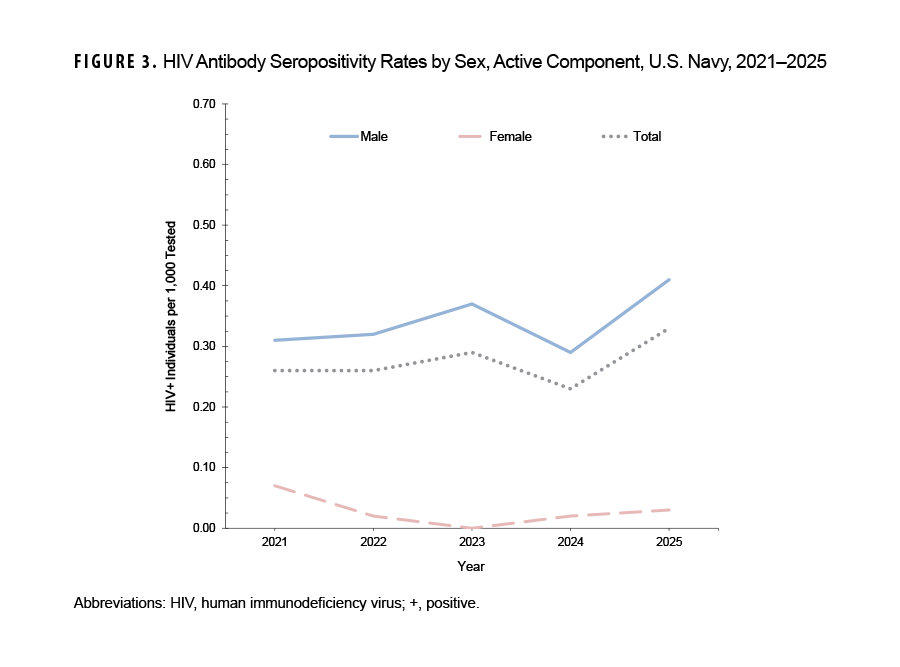
A total of 173,291 members of the U.S. Navy active component were tested for HIV antibodies in 2025; 57 were identified as HIV-antibody-positive (seropositivity 0.33 per 1,000 tested), marking the service branch’s highest seropositivity rate since 2021 (Table 4, Figure 3). Annual seropositivity rates for male active component sailors were considerably higher than the seropositivity rates of female active component soldiers (Figure 3). On average, 1 new HIV infection per 3,284 screening tests was detected among active component sailors in 2025. Of the 262 active component sailors diagnosed with HIV infection since 2021, 204 (77.9%) were still in service in 2025.
Navy Reserve
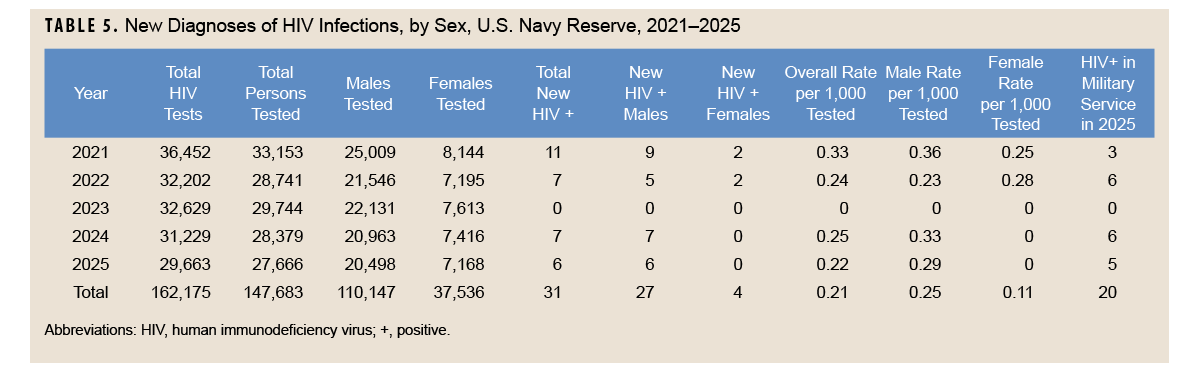
In 2025, a total of 27,666 members of the U.S. Navy Reserve were tested for HIV antibodies; 6 sailors were identified as HIV-antibody-positive (seropositivity 0.22 per 1,000 tested) (Table 5). On average, 1 new HIV infection was detected per 4,944 screening tests among Navy reservists in 2025. Of the 31 reserve component sailors diagnosed with HIV infection since 2021, 20 (64.5%) were still in service in 2025.
U.S. Air Force, active component
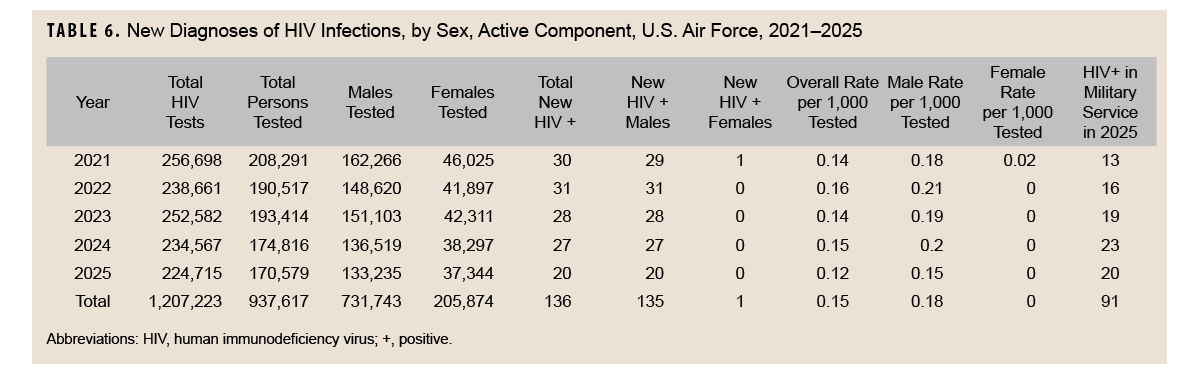
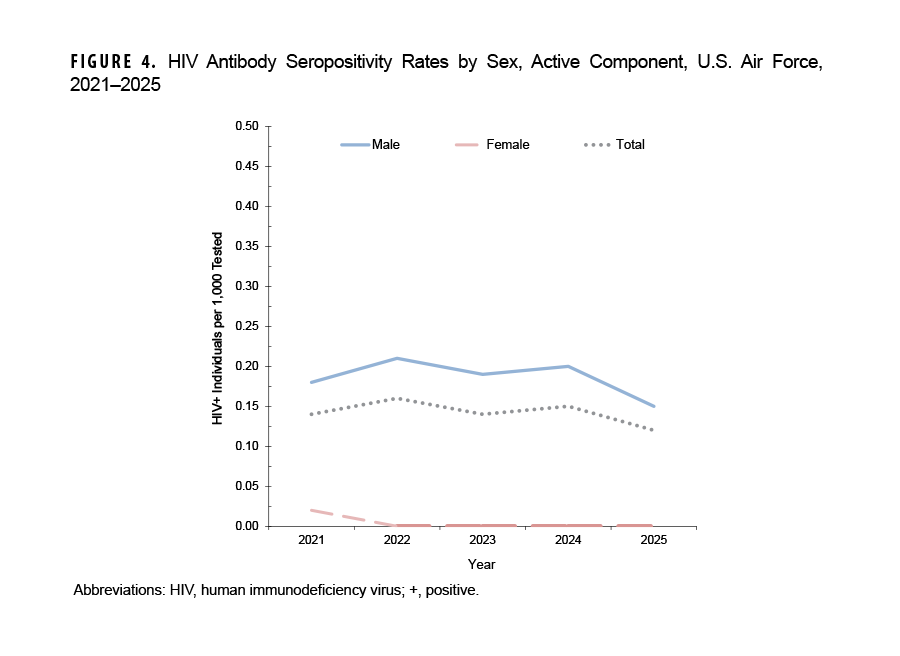
In 2025, a total of 170,579 U.S. Air Force active component members were tested for HIV antibodies; 20 were diagnosed with HIV infection (seropositivity 0.12 per 1,000 tested) (Table 6). The seropositivity rate among male Air Force service members reached its lowest level in 2025 (Figure 4). On average, 1 new HIV infection per 11,236 screening tests was detected among active component Air Force members in 2025. Of the 136 active component Air Force members diagnosed with HIV infection since 2021, 91 (66.9%) were still in service in 2025.
Air National Guard
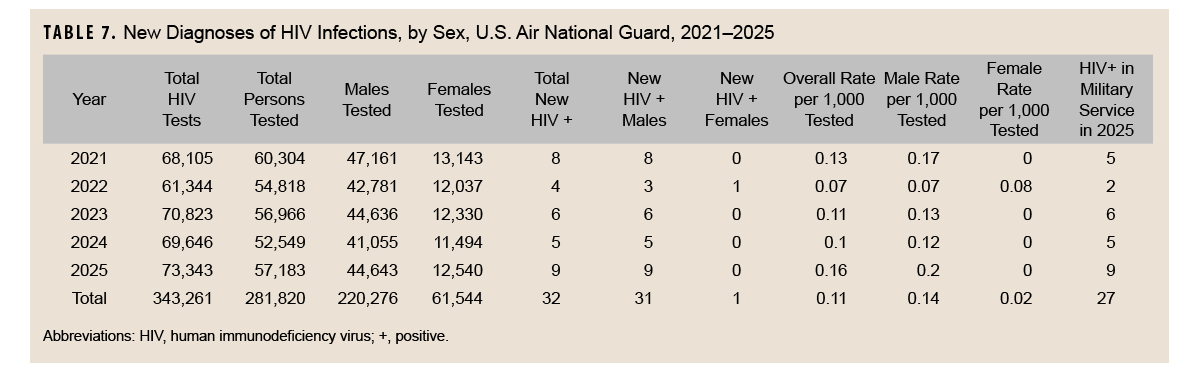
In 2025, a total of 57,183 members of the Air National Guard were tested for HIV antibodies; 9 were diagnosed with HIV infection (seropositivity 0.16 per 1,000 airmen tested) (Table 7). On average, 1 new HIV infection per 8,149 screening tests was detected among Air National Guard members in 2025. Of the 32 Air National Guard members diagnosed with HIV infection since 2021, 27 (84.4%) were still in service in 2025.
Air Force Reserve
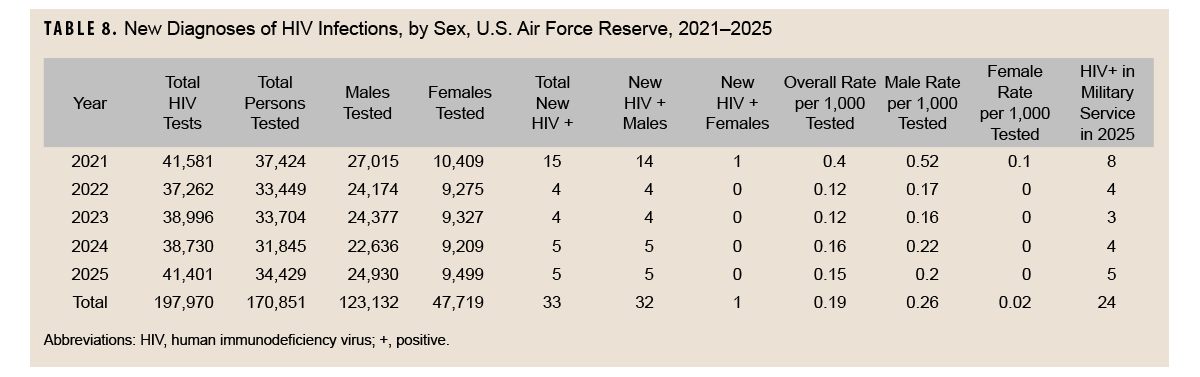
In 2025, a total of 34,429 members of the Air Force Reserve were tested for HIV antibodies; 5 were diagnosed with HIV infection (seropositivity 0.15 per 1,000 tested) (Table 8). On average, 1 new HIV infection per 8,280 screening tests was detected among Air Force reservists in 2025. Of the 33 Air Force reservists diagnosed with HIV infection since 2021, 24 (72.7%) were still in service in 2025.
U.S. Marine Corps, active component
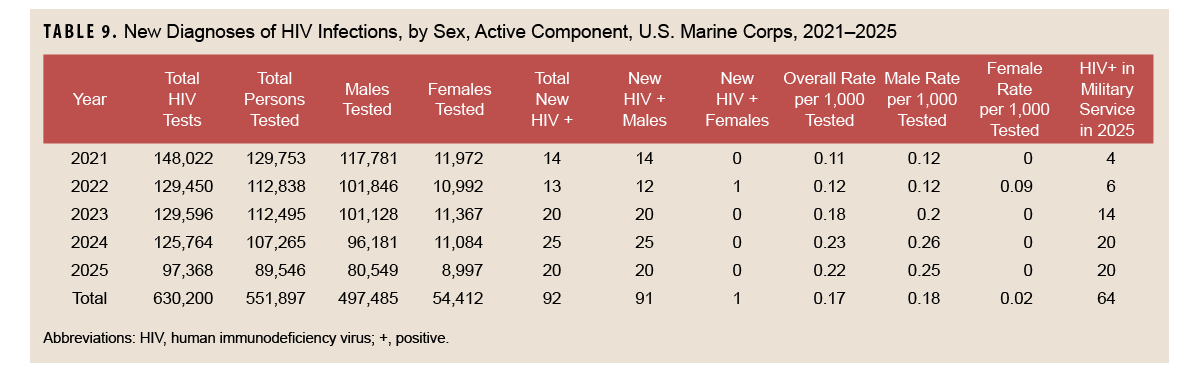
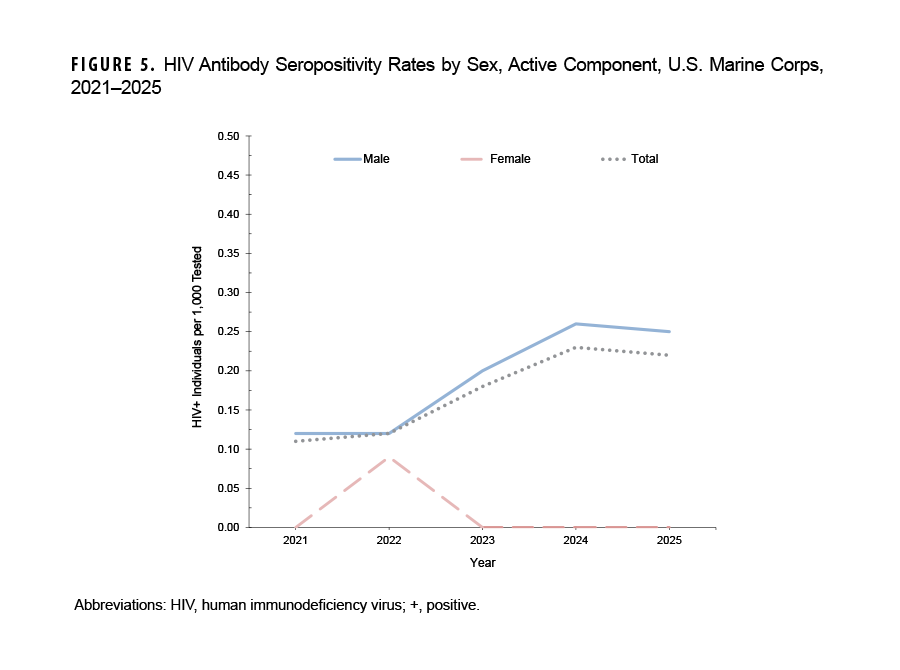
In 2025, a total of 89,546 active component members of the U.S. Marine Corps were tested for HIV antibodies; 20 were identified as HIV-antibody-positive (seropositivity 0.22 per 1,000 tested) (Table 9). Annual seropositivity rates rose from a low of 0.11 per 1,000 tested in 2021 to a high of 0.23 per 1,000 in 2024 (Table 9, Figure 5). On average, 1 new HIV infection per 4,868 screening tests was detected among active component marines in 2025. Of the 92 active component marines diagnosed with HIV infection since 2021, 64 (69.6%) were still in service in 2025.
Marine Corps Reserve
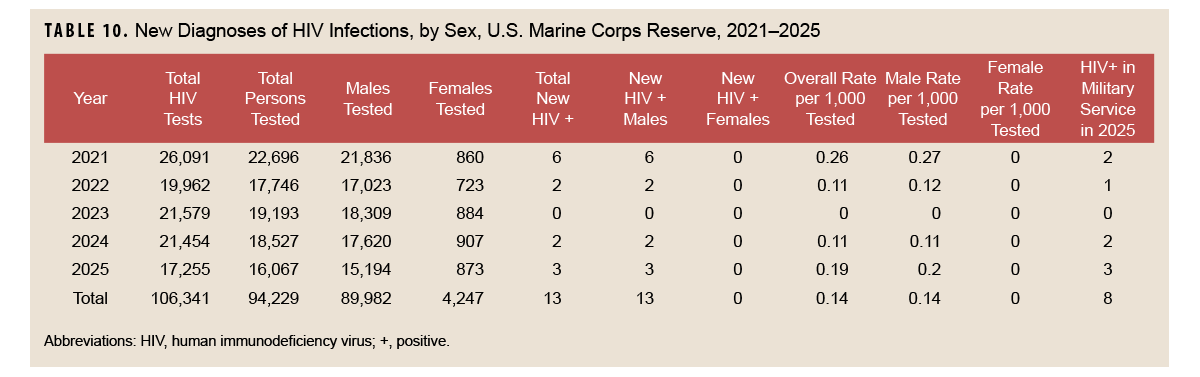
In 2025, a total of 16,067 Marine Corps Reserve members were tested for HIV antibodies; 3 were identified as HIV-antibody-positive (seropositivity 0.19 per 1,000 tested) (Table 10). On average, 1 new HIV infection per 5,752 screening tests was detected among Marine Corps reservists in 2025. Of the 13 active component Marine reservists diagnosed with HIV infection since 2021, 8 (61.5%) were still in service in 2025.
U.S. Coast Guard, active component
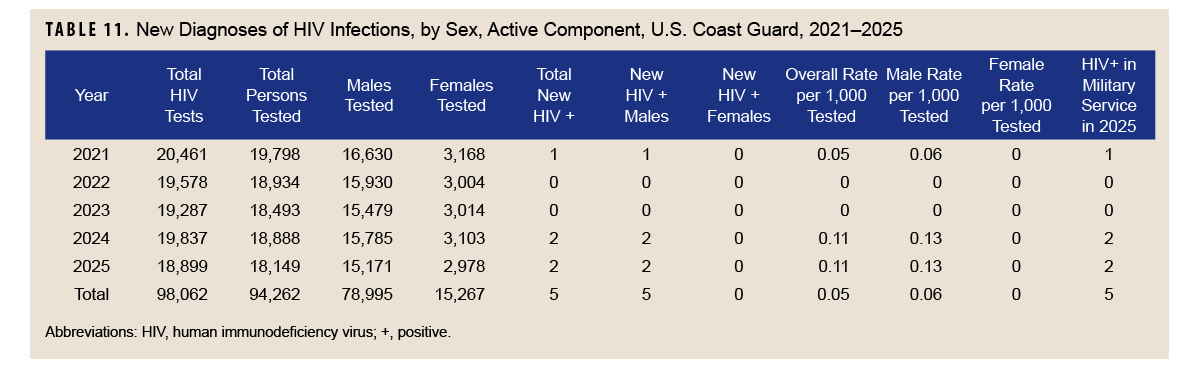
In 2025, a total of 18,149 U.S. Coast Guard active component service members were tested for HIV antibodies; 2 were identified as HIV-antibody-positive (seropositivity 0.11 per 1,000 tested) (Table 11). On average, 1 new HIV infection per 9,450 screening tests was detected among U.S. Coast Guard active component members in 2025. All 5 active component Coast Guard members diagnosed with HIV infection since 2021 were still serving in 2025.
Coast Guard Reserve
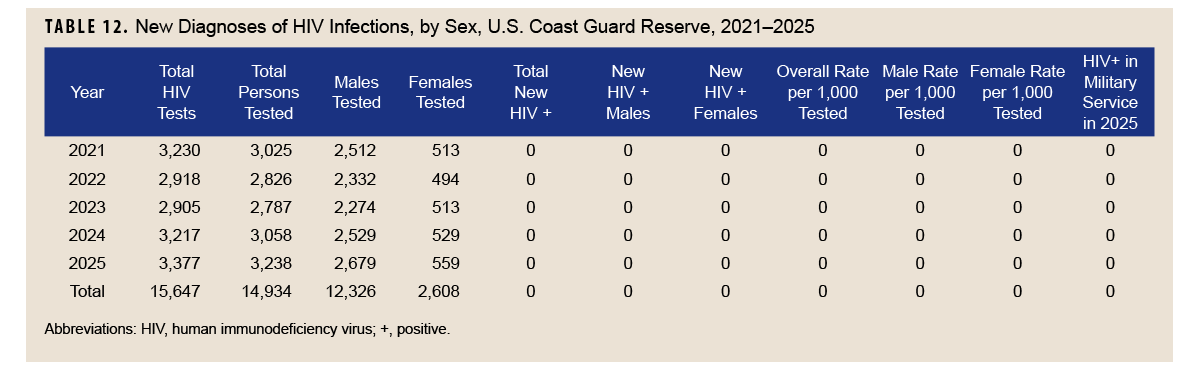
In 2025, a total of 3,238 U.S. Coast Guard Reserve members were tested for HIV antibodies, with none identified as HIV-antibody-positive (Table 12).
Discussion
The 2025 surveillance data for HIV infection among the U.S. military demonstrate historical stability, with an overall seropositivity rate of 0.22 per 1,000 tested, closely adhering to both the 2025 rate (0.21 per 1,000 tested) and historical comparisons established in the mid-1990s.4,5 For nearly 4 decades, the U.S. military has routinely screened service members and civilian applicants, successfully balancing clinical vigilance with force preservation.6-9 As early as 1995, the U.S. Army processed roughly 1.1 million specimens annually, establishing an economically efficient, scalable model for force-wide HIV monitoring that persists today.10
The progression of career longevity highlights the modern era of the military's HIV program. Following the June 2022 DOW policy updates, which prohibited the discharge of asymptomatic service members with undetectable viral loads, retention rates have risen substantially. While only 26% of HIV-positive soldiers remained in uniform 1990–1994,5 current data show that 68.7% of active component Army soldiers diagnosed since 2021 continue to serve.
Demographically, new diagnoses remain concentrated among young male service members, with personnel younger than age 25 years accounting for over 41% of cases in 2025. This demographic distribution corroborates the 2022–2025 National HIV/AIDS Strategy focus on youth ages 13-24 years.
Because this study population underwent rigorous pre-entry screening and entered military service confirmed as negative for HIV seroprevalence, these findings reflect a highly selected population and should not be generalized to the wider, unscreened public. This distinction is further compounded by the fact that civilian applicant data from the U.S. Military Entrance Processing Command have not been integrated into the DMSS since 2020; this report therefore documents only active and reserve personnel who sero-converted after starting military service. These rates reflect incident infections acquired during uniformed service and are not directly comparable to civilian surveillance reports.
Periodic, mandatory testing of active and reserve personnel, coupled with the routine screening of civilian applicants, remains a cornerstone of the DOW’s HIV control and clinical management efforts.12 The seropositivity rates for HIV in 2025 documented the U.S. Armed Forces underscore that the comprehensive screening program is still a vital instrument of force health protection. This clinical vigilance is especially critical for male service members younger than age 35 years, who continue to evince the highest rate of new diagnoses in all branches and components of the U.S. Armed Forces.
Only 34 female service members were newly identified as HIV-antibody-positive during the 2021-2025 surveillance period, corresponding to a substantially lower seropositivity rate than that observed among male service members. This low testing result yield warrants additional evaluation of the resource implications and population-specific effectiveness of routine HIV screening among female service members; these surveillance data alone, however, cannot determine whether sex-specific changes in testing policy would maintain timely case detection and force health protection.
References
- U.S. Department of Defense. Department of Defense Instruction 6485.01: Human Immunodeficiency Virus (HIV) in Military Service Members. Updated Jun. 6, 2022. Accessed Oct. 17, 2024. https://www.esd.whs.mil/portals/54/documents/dd/issuances/dodi/648501p.pdf
- Aumakhan B, Eick-Cost AA, Oh GT, Stahlman S, Johnson R. Four decades of HIV antibody screening in the U.S. military: a review of incidence and demographic trends, 1990–2024. MSMR. 2025;32(4):13-20. Accessed Oct. 9, 2025. https://www.health.mil/reference-center/reports/2025/04/01/msmr-vol-32-no-4-apr-2025
- Office of the Secretary of Defense. Secretary of Defense Memorandum for Senior Pentagon Leadership, Commanders of the Combatant Commands, Defense Agency and DOD Field Activity Directors: Policy Regarding Human Immunodeficiency Virus-Positive Personnel Within the Armed Forces. U.S. Dept. of War. Jun. 6, 2022. Accessed Jan. 13, 2026. https://media.defense.gov/2022/jun/07/2003013398/-1/-1/1/policy-regarding-human-immunodeficiency-virus-positive-personnel-within-the-armed-forces.pdf
- Armed Forces Health Surveillance Center. Routine screening for antibodies to human immunodeficiency virus in the U.S. Armed Forces, active and reserve components, January 2020–June 2025. MSMR. 2025;32(11):25-33. Accessed Oct. 7, 2026. https://www.health.mil/reference-center/reports/2024/10/01/msmr-vol-31-no-10-oct-2024
- Army Medical Surveillance Activity. Supplement: HIV-1 in the Army. MSMR. 1995;1(3):12-15. Accessed Oct. 9, 2025. https://www.health.mil/reference-center/reports/1995/01/01/medical-surveillance-monthly-report-volume-1-number-3
- Brown AE, Brundage JF, Tomlinson JP, Burke DS. The U.S. Army HIV testing program: the first decade. Mil Med. 1996;161(2):117-122. doi:10.1093/milmed/161.2.117
- Armed Forces Epidemiological Board. Testing Interval for Human Immunodeficiency Virus (HIV-1) Infection in Military Personnel–2003-05. U.S. Dept. of War. Updated Mar. 29, 2004. Accessed Oct. 17, 2024. https://www.health.mil/reference-center/policies/2004/03/29/policy-memorandum-humanimmunodeficiency-virus-interval-testing
- Office of the Under Secretary of Defense for Personnel and Readiness. Department of Defense Instruction 6485.01: Human Immunodeficiency Virus (HIV) in Military Service Members. U.S. Dept. of War. Updated Jun. 6, 2022. Accessed Oct. 17, 2024. https://www.esd.whs.mil/portals/54/documents/dd/issuances/dodi/648501p.pdf
- Office of the Under Secretary of Defense for Personnel and Readiness. Department of Defense Instruction 6130.03, Volume 1: Medical Standards for Appointment, Enlistment, or Induction. U.S. Dept. of War. Updated May 28, 2024. Accessed Oct. 17, 2024. https://www.esd.whs.mil/portals/54/documents/dd/issuances/dodi/613003_vol01.pdf?ver=b0uhh9e1k_mdtz4punu8aw%3d%3d
- Brown AE, Burke DS. Cost of HIV testing in the U.S. Army. NEJM. 1995;332(14):963. doi:10.1056/nejm199504063321419
- U.S. Department of Health and Human Services. National HIV/AIDS Strategy for the United States 2022–2025. HIV.gov. White House Office of National AIDS Policy;2021. Accessed Jan. 13, 2026. https://files.hiv.gov/s3fs-public/NHAS-2022-2025.pdf
- Okulicz JF, Beckett CG, Blaylock JM, et al. Review of the U.S. military’s human immunodeficiency virus program: a legacy of progress and a future of promise. MSMR. 2017;24(9):2-7. Accessed Oct. 9, 2025. https://www.health.mil/reference-center/reports/2017/01/01/medical-surveillance-monthly-report-volume-24-number-9
Acknowledgment
The editors thank Mr. Gi-Taik Oh, MS, Principal Research Analyst, Epidemiology and Analysis Branch, Armed Forces Health Surveillance Division, for analyzing the data presented in this report.
Disclaimers
The views expressed in this report reflect the results of research conducted by the authors and do not necessarily reflect official policy nor position of the Defense Health Agency, Department of War, or the U.S. Government.
The editors disclose use of an artificial intelligence (AI) language model in the preparation of this report. Assistance was provided by Gemini Enterprise, a large language model from Google optimized specifically for Department of War mission support within an Impact Level 5 (IL5) environment. This AI application was used to assist with initial drafts of the discussion to refine prose for clarity. MSMR editors directed all AI review and analysis, with subsequent editorial staff review and final edits. The editors assert full responsibility for the accuracy and integrity of the final content.