Surveillance snapshot: Trends in tobacco use and cessation counseling encounters among U.S. active component service members, 2018–2025

Increased electronic cigarette use has coincided with a corresponding decrease in traditional cigarette smoking in the U.S.

Recent studies highlight shifting tobacco consumption patterns among national and military populations.1,2 Nationally, increasing electronic cigarette (‘e-cigarette’) use has coincided with a corresponding decrease in traditional cigarette smoking among U.S. adults.1 Concurrently, tobacco cessation counseling services within the Military Health System (MHS) has steadily declined.2 To address these evolving dynamics, this Surveillance Snapshot describes self-reported tobacco product use in conjunction with trends of coded encounters for tobacco cessation counseling from 2018 through 2025 among U.S. active component service members (ACSMs).

Annual tobacco use prevalence among ACSMs was determined through the Periodic Health Assessment (PHA), from which service members from all branches of the U.S. Armed Forces who reported any tobacco use within the last 30 days were counted as users; annual trends for the most common single-use tobacco products were also evaluated. To evaluate clinical cessation support, medical encounters were identified using either an International Classification of Diseases, 10th Revision (ICD-10) diagnosis code (Z71.6) or Current Procedural Terminology (CPT) codes (99406, 99407) for tobacco cessation counseling. The annual proportion of ACSM tobacco users receiving clinical cessation therapy was estimated by dividing the number of ACSMs with at least 1 counseling encounter by the total number of self-reported tobacco users identified via the PHA.

Overall, the prevalence of any self-reported tobacco use declined steadily, from 25.5% in 2018 to 20.4% in 2025 (data not shown). As shown in the Figure, use of traditional tobacco products such as cigarettes and chewing tobacco declined throughout the surveillance period. Notably, cigarette use among service members ages 18-24 years fell from 14.1% to 6.0%, while prevalence for all other age cohorts dropped below 4.0% by 2025 (data not shown). Concurrently, clinical engagement for tobacco cessation declined, falling from 7.6% in 2018 to a low of 1.8% in 2024.
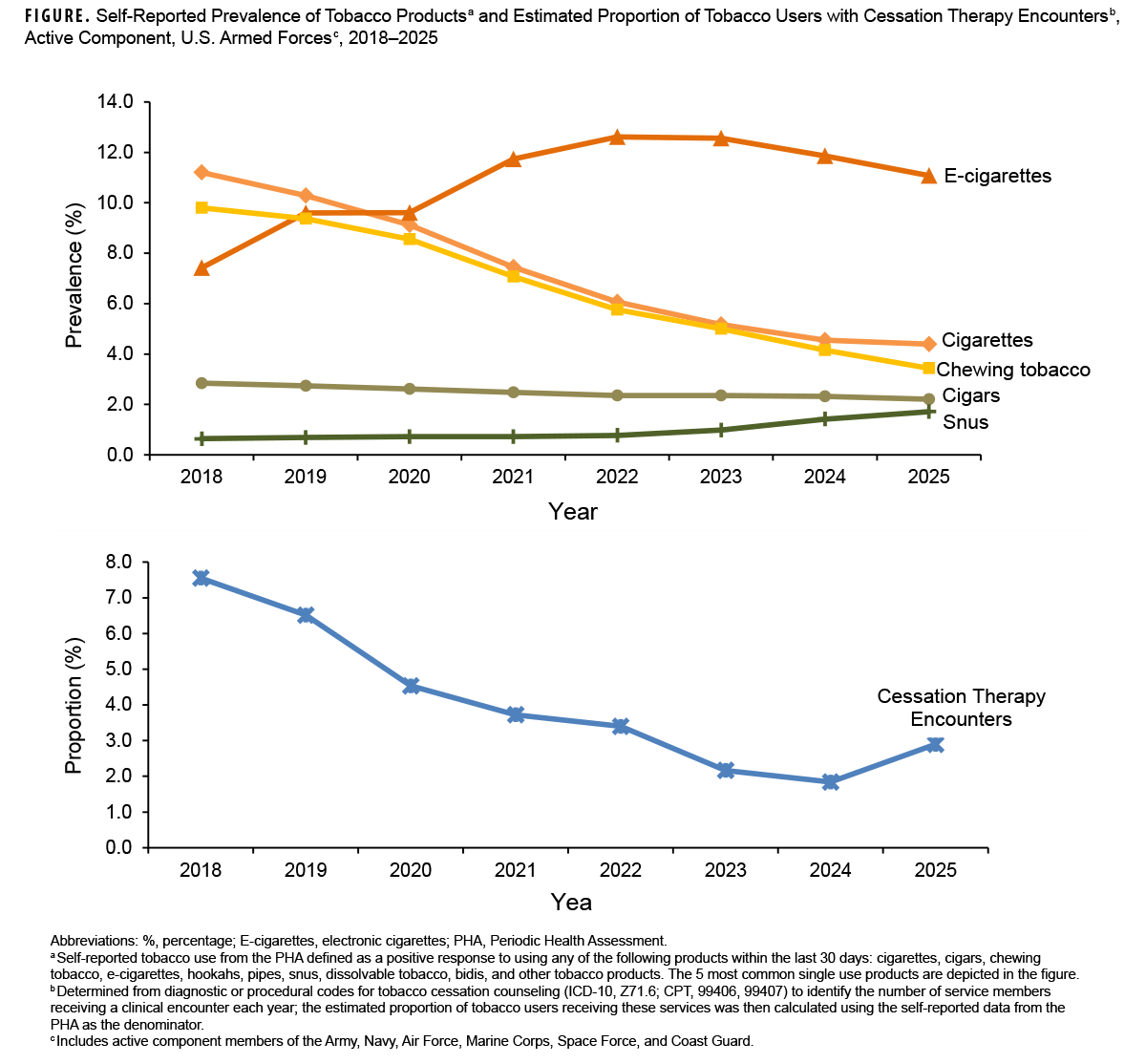
FIGURE. Self-Reported Prevalence of Tobacco Products and Estimated Proportion of Tobacco Users with Cessation Therapy Encounters, Active Component, U.S. Armed Forces, 2018–2025 This figure consists of two stacked line graphs over the period from 2018 to 2025. The top graph tracks the self-reported prevalence percentage of five tobacco products: cigarettes, e-cigarettes, chewing tobacco, cigars, and snus. It demonstrates a massive rise in e-cigarette use, which nearly doubled and peaked in 2022 at approximately 12.6% before settling at 11.0% in 2025, while traditional cigarettes and chewing tobacco declined steadily (cigarettes fell from 9.8% to 4.4%, chewing tobacco from 9.8% to 3.4%). The bottom graph maps the estimated proportion of tobacco users with clinical encounters for cessation therapy, showing a stark downward trend from 7.6% in 2018 to a historic low of 1.8% in 2024, with a slight rebound to 2.9% in 2025.

In contrast, e-cigarette use increased during the surveillance period, surpassing traditional cigarettes after 2020 and peaking in 2022 to become the most reported product. E-cigarette use nearly doubled between 2018 and 2023 in both the Army (7.4% to 14.6%) and Marine Corps (9.8% to 18.5%) (data not shown). Over the 8-year period, reported snus (tobacco pouch) use nearly tripled (0.6% to 1.7%), and dissolvable tobacco increased more than 17-fold, although its absolute prevalence remained low (0.04% to 0.70%) (data not shown).

Several methodological caveats should be considered when interpreting these data. Because this analysis relies strictly on structured CPT and diagnostic billing codes, it measures dedicated, timed counseling sessions rather than brief, point-of-care screenings. Additionally, this analysis does not include other critical components of cessation such as pharmacotherapy. The decline in documented counseling could indicate a shift in treatment approaches, with health care providers potentially focusing on medication-based therapies without separately-coded counseling sessions. Since this analysis employed population-level estimates rather than deterministic individual records, it could not verify that every individual in the numerator (i.e., clinical encounter) was represented in the denominator (i.e., self-reported PHA tobacco users). Consequently, the calculated proportions represent a population-level estimate of counseling services relative to estimated prevalence. Finally, the estimation of tobacco users from self-reported data may be under-estimated due to social desirability bias, as demonstrated in prior analyses.3

The discordant trends in clinical encounters for cessation counseling and e-cigarette use require additional study. Future analyses should integrate and investigate pharmacy data for cessation medications. Evaluating pharmacological records as well as clinical encounter trends will clarify whether the decline in coded encounters for counseling cessation reflects a genuine gap in care or a systemic shift toward medication-centric treatment models.

References

  1. Foxon F, Selya A, Gitchell J, Shiffman S. Increased e-cigarette use prevalence is associated with decreased smoking prevalence among US adults. Harm Reduct J. 2024;21(1):136. doi:10.1186/s12954-024-01056-0 
  2. Patrick S, Boyle C, LaMorte D, Dore M. Tobacco use prevalence in the Military Health System: a retrospective study. Mil Med. 2024;189(11-12):e2632-e2637. doi:10.1093/milmed/usae208 
  3. Rossi KR, Russell SJ, Mabila SL. Distribution of tobacco and nicotine use indicators from the Periodic Health Assessment and medical diagnostic codes among U.S. active component service members, 2023. MSMR. 2026;33(4):3-9. Accessed Oct. 15, 2026. https://www.health.mil/news/articles/2026/04/01/msmr-pha-icd-tobacco-nicotine-use

Authors’ Affiliation

Epidemiology and Analysis Branch, Armed Forces Health Surveillance Division, Public Health Directorate, Defense Health Agency, Silver Spring, MD: Ms. Rossi, Mr. Russell, Dr. Mabila

Disclaimer

The views expressed in this report reflect the results of research conducted by the authors and do not necessarily reflect official policy nor position of the Defense Health Agency, Department of War, or the U.S. Government.

You also may be interested in...

Report
Nov. 1, 2026

MSMR Vol. 33 No. 11 - November 2026

.PDF | 2.34 MB

The November 2026 MSMR presents the annual update of sexually transmitted infections among U.S. active component service members; complemented by the annual update of routine HIV screening in the active and reserve components; followed by a report on associations between the Military Health System GENESIS electronic health record transition and ...

Report
Oct. 1, 2026

MSMR Vol. 33 No. 10 - October 2026

.PDF | 1.74 MB

The October 2026 MSMR presents two full reports including a case study, in addition to one brief report and a Surveillance Snapshot. The issue features a study of flea-borne typhus fever in the U.S. military; followed by a case report of a delayed onset Plasmodium vivax malaria infection after exposure near the Demilitarized Zone (DMZ) in the Republic ...

Report
Sept. 1, 2026

MSMR Vol. 33 No. 9 - September 2026

.PDF | 2.51 MB

The September 2026 MSMR presents four full reports, beginning with a retrospective cohort study on health outcomes of U.S. active component service members working in high risk occupations for blast overpressure exposure; followed by an inaugural Public Health Practice feature on a standardized approach to non-infectious disease cluster investigations ...

Report
Aug. 1, 2026

MSMR Vol. 33 No. 8 - August 2026

.PDF | 3.15 MB

The August 2026 issue of MSMR presents the annual report on diagnoses of mental health disorders among U.S. active component service members (ACSMs), 2021-2025; with a related report on trends in postpartum depression and anxiety diagnoses among U.S. active component service women, 2010-2024; complemented by a report on chronic insomnia and military ...

Report
July 1, 2026

MSMR Vol. 33 No. 6 -7 - June-July 2026

.PDF | 3.23 MB

The June-July 2026 MSMR presents the annual burden of morbidity issue, with data and analysis of absolute and relative morbidity burdens due to illnesses and injuries in 2025 among U.S. active component and reserve service members, as well as Military Health System beneficiaries.

Report
May 1, 2026

MSMR Vol. 33 No. 5 - May 2026

.PDF | 2.07 MB

The May 2026 MSMR features four full reports and a brief report, beginning with the annual update of heat exhaustion and heat stroke among U.S. active component service members, 2021–2025; complemented by the annual updates on exertional rhabdomyolysis and exertional hyponatremia among active component service members, 2021–2025; followed by the ...

Report
April 1, 2026

MSMR Vol. 33 No. 4 - April 2026

.PDF | 1.30 MB

The April 2026 MSMR features two full reports and a brief report, beginning with a study of tobacco and nicotine use indicators from two data sources for U.S. active component service members in 2023; followed by a report on head and neck cancer among active component service members from 2010 to 2024; with brief report on the incidence of ...

Report
March 1, 2026

MSMR Vol. 33 No. 3 - March 2026

.PDF | 1.74 MB

The March 2026 MSMR features two full reports and a Surveillance Snapshot, beginning with a report on mortality rates among U.S. service members, from 2010 to 2020; followed by a report on the incidence and burden of endometriosis among U.S. active component service women, 2017 to 2024; with a Surveillance Snapshot on mid-year populations by sex, age, ...

Report
Feb. 1, 2026

MSMR Vol. 33 No. 2 - February 2026

.PDF | 1.29 MB

The February 2026 MSMR features a report on the number of tuberculosis tests and diagnoses of latent tuberculosis infection in the U.S. Army; a historical review on post-infection symptoms in U.S. soldiers with malaria during World War II and its major limitation to return to duty; a Surveillance Snapshot on adherence to disease and injury ...

Report
Jan. 1, 2026

MSMR Vol. 33 No. 1 - January 2026

.PDF | 3.43 MB

The January 2026 MSMR features a full report on Guillain-Barré syndrome among U.S. active component service members, 2014–2022; and a report on distinct approaches to racial and ethnic classification to the surveillance of obstetric and neonatal outcomes in the U.S. military, 2010–2021; followed by a case report an atypical Ross River virus infection ...

Report
Dec. 1, 2025

MSMR Vol. 32 No. 12 - December 2025

.PDF | 2.86 MB

The December 2025 issue of MSMR features four full reports: the annual update on cold weather injuries among the active and reserve components; a report on trends in the prevalence of obesity among U.S. active component service members and civilians; the annual update on diagnoses of mental health disorders among active component service members; a ...

Report
Nov. 1, 2025

MSMR Vol. 32 No. 11 - November 2025

.PDF | 3.56 MB

The November 2025 MSMR presents four full reports on sexually transmitted infections (STIs), led by the annual update on STIs among active component service members, 2016–2024; followed by a report on follow up testing for chlamydia or gonorrhea among male Air Force basic trainees, 2017–2023; accompanied by a report on sexual networks of service ...

Report
Oct. 1, 2025

MSMR Vol. 32 No. 10 - October 2025

.PDF | 2.90 MB

The October 2025 MSMR presents five full reports: measles, mumps, rubella and varicella within the Military Health System; seasonal influenza hospitalization among service members; BMI, physical fitness, and COVID-19 hospitalization in the Army; adverse pregnancy outcomes in female service members after COVID-19 infection or vaccination; long COVID ...

Report
Aug. 1, 2025

MSMR Vol. 32 No. 8 - August 2025

.PDF | 2.71 MB

The August 2025 MSMR presents four articles: a report on venomous animal bites and stings in U.S. active component service members, 2008–2023; a report on potential high arbovirus exposure in INDOPACOM during U.S. deployment or exercises in Papua New Guinea; a Historical Perspective on early U.S. military immunization against tetanus and diphtheria; ...

Refine your search