What are the new findings?
In 2025, musculoskeletal system conditions were the leading cause of in-theater medical care in U.S. Africa Command (AFRICOM), U.S. Central Command (CENTCOM), and U.S. Southern Command (SOUTHCOM), while in U.S. Pacific Command (PACOM) mental health disorders were the leading cause of medical care. This year’s expanded analysis, including 4 combatant commands, of deployed service member health care, reveals that CENTCOM accounted for almost 90% of all in-theater medical encounters in 2025.
What is the impact on readiness and force health protection?
Optimization of operational readiness and the minimization of preventable lost duty time each requires the prioritization of robust, in-theater mental health assets and targeted musculoskeletal injury prevention programs. Thorough examination of the most common causes of injury and illness during deployment can assist senior leaders in developing and implementing strategies to reduce preventable medical issues, enhance force readiness, and ensure fighting strength.
Background
Each year, MSMR estimates illness- and injury-related morbidity and health care burdens within the U.S. Armed Forces and Military Health System (MHS). This report updates prior analyses of the distributions of the burdens of health care for active and reserve component service members in deployed settings. While deployed service members are selected primarily from the active component of the U.S. Armed Forces, the reserve component contributes a substantial portion of U.S. deployed forces.
This report employs data from the Theater Medical Data Store (TMDS), which documents service members’ inpatient and outpatient medical encounters during treatment in an operational environment. TMDS receives medical data from Theater Medical Information Program-Joint (TMIP-J) applications, including AHLTA-Theater (AHLTA-T), TMIP-Composite Health Care System Cache (TC2), Mobile Computing Capability (MCC), Maritime Medical Modules (MMM), and the U.S. Transportation Command Regulating and Command and Control Evacuation System (TRAC2ES).1
While the U.S. Africa Command (AFRICOM) area of responsibility (AOR) was first included in this annual report in 2021, this year’s iteration presents the first comprehensive inclusion of 4 major geographic combatant commands. To accurately reflect the geographic distribution of U.S. force deployment, medical evacuation surveillance has expanded. In accordance with the National Defense Strategy’s focus on global strategic competition, operational tempos remain high, with U.S. forces increasingly dispersed in multiple theaters to deter aggression and build regional alliances.2 Following the reduction of large-scale U.S. combat operations in the U.S. Central Command (CENTCOM) AOR in late 2021, the global geographic distribution of U.S. military operations shifted significantly, but in order to sustain counterterrorism successes, global force deployments continue to assist, advise, and accompany allied security forces.3
Methods
The surveillance population included all individuals who served in the active or reserve components of the U.S. Army, Navy, Air Force, Marine Corps, or Space Force with health care encounters captured in the TMDS during the surveillance period. Analysis was restricted to encounters where the theater of care was specified as AFRICOM, CENTCOM, U.S. Pacific Command (PACOM, formerly Indo-Pacific Command or INDOPACOM), or U.S. Southern Command (SOUTHCOM), or where the name of the theater of operation was missing or null; by default, this excluded encounters in U.S. Northern Command (NORTHCOM) and U.S. European Command (EUCOM). In addition, TMDS-recorded medical encounters where the data source was identified as Shipboard Automated Medical System (SAMS), or where the military facility descriptor indicated that care was provided aboard ship, were excluded from this analysis. Encounters from aeromedical staging facilities outside AFRICOM, CENTCOM, PACOM, or SOUTHCOM were also excluded.
Morbidity burdens attributable to various conditions were estimated by distributions of diagnoses according to the 17 traditional categories of the International Classification of Diseases (ICD) system, with an 18th category for COVID-19. Extended ICD-10 (10th Revision) code groupings were also reviewed for the most common diagnoses. The TMDS has not fully transitioned to ICD-10 codes, so some ICD-9 (9th Revision) codes were included. Primary diagnoses that did not correspond to an ICD-9 or ICD-10 code are not reported in this burden analysis.
Results
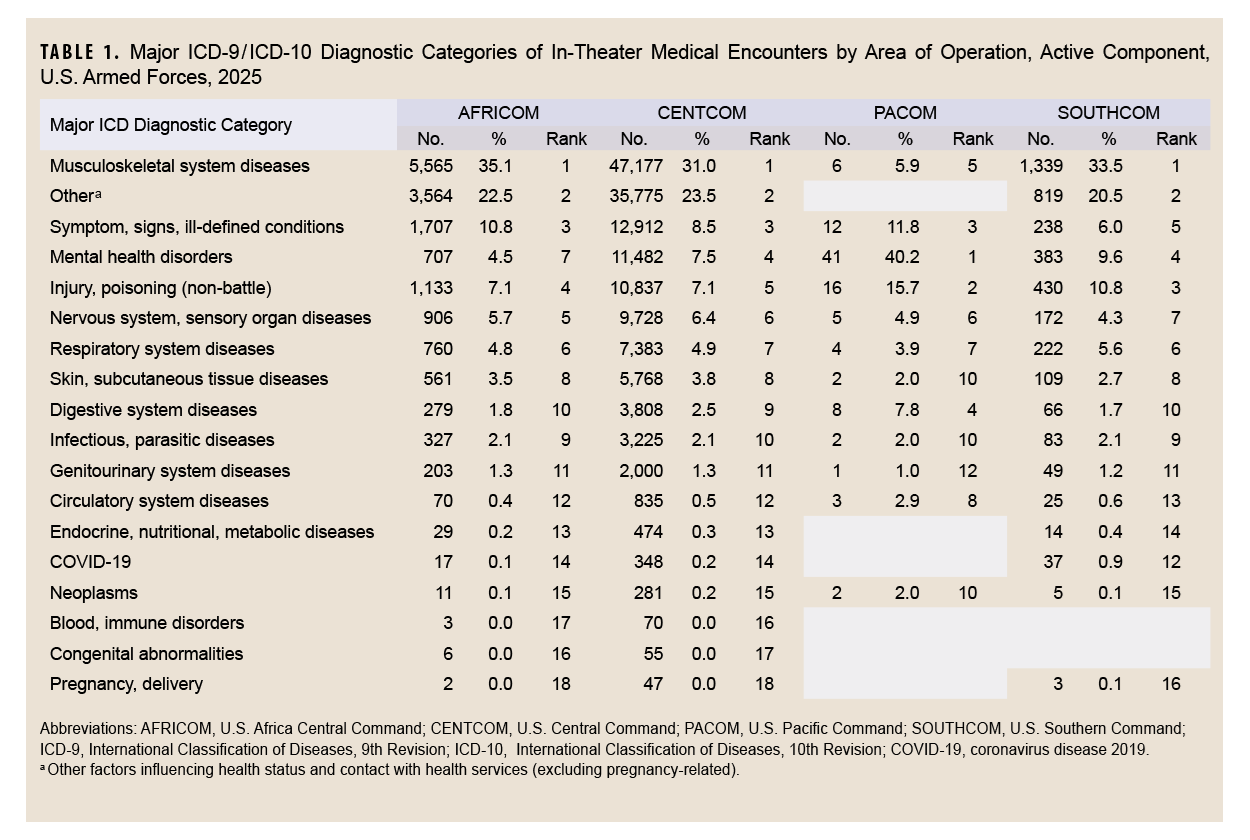 Among the 75,204 U.S. service members deployed in 2025 to AFRICOM, CENTCOM, PACOM, and SOUTHCOM, in total 172,878 medical encounters occurred. Of those documented medical encounters among deployed service members in 2025, 466 (0.27%) were recorded as hospitalizations. Most medical encounters (n=129,822, 75.0%), individuals affected (n=40,596, 80.6%), and hospitalizations (n=363, 78.0%) occurred among male service members (data not shown). In 2025, CENTCOM evinced the highest overall volume of in-theater medical encounters, far exceeding other combatant commands (Table 1), with over 152,000 total recorded diagnoses among all ICD categories. In 2025, the largest percentages of medical encounters attributed to a major ICD-10 diagnostic category were coded as musculoskeletal system diseases, followed by ‘other’ or administrative health services (‘Z’ codes, include factors influencing health status and health service contact) (Figure). The most common diagnosis within the musculoskeletal system diseases category was for lower back pain (ICD-10 code M545) (Table 2). The percentage of total medical encounters attributed to ‘other’ health services decreased from 44.0% in 2021 to 23.3% in 2025. COVID-19 accounted for only 0.2% of deployed service members’ total medical encounters in 2025.
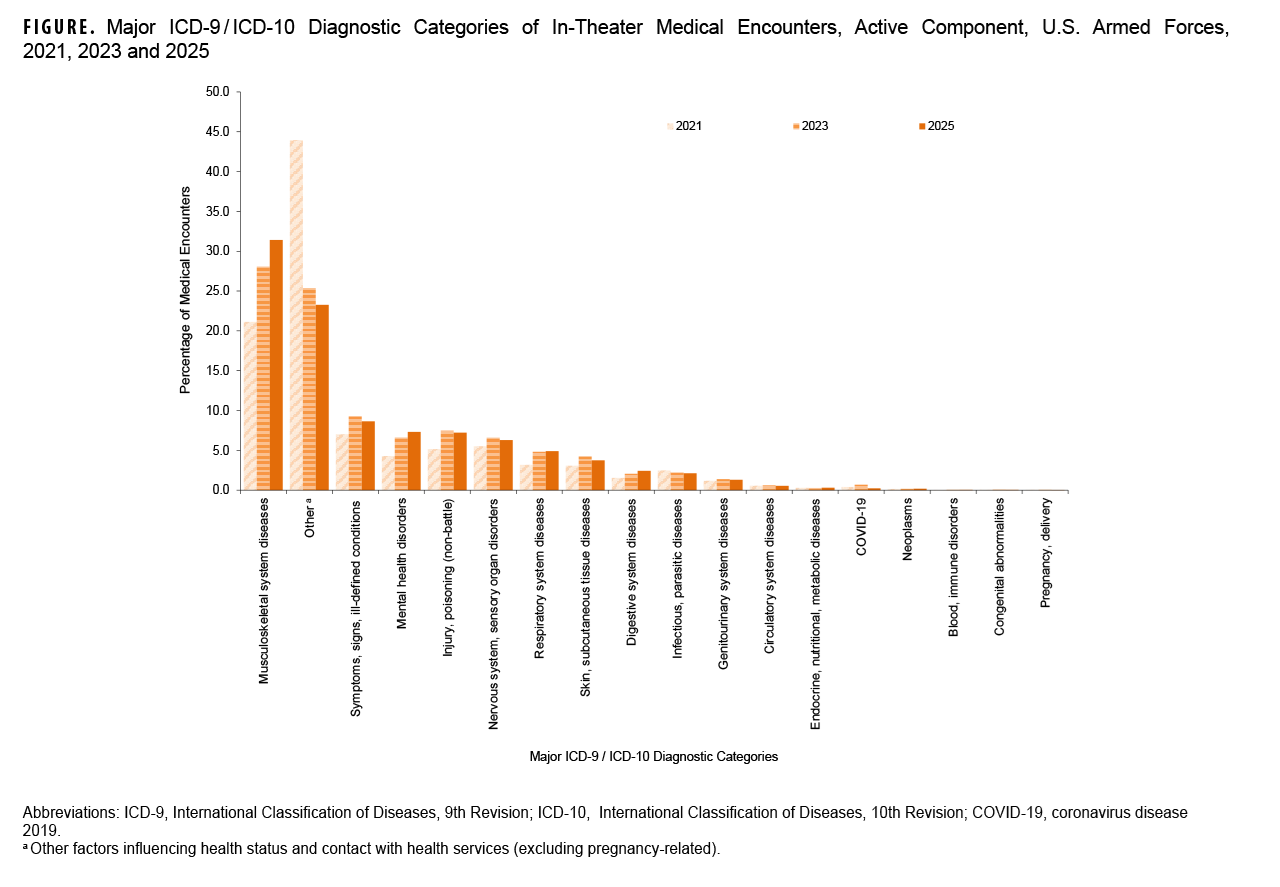
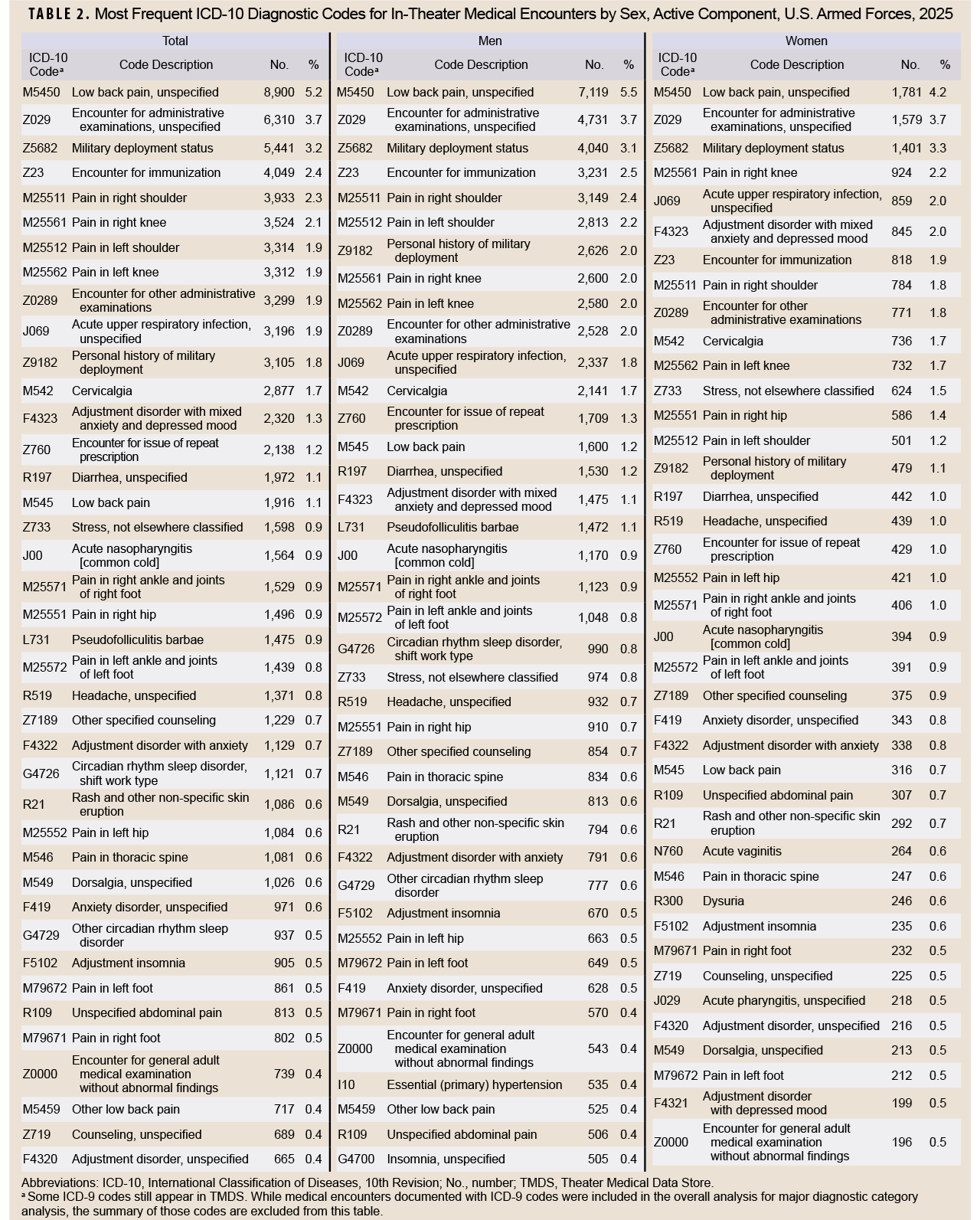
The percentages of in-theater medical encounters attributed to musculoskeletal system diseases increased (21.1% to 31.4%) from 2021 to 2025 (Figure). Lower back pain was the most frequent ICD-10 diagnostic code (M545) for musculoskeletal disease encounters for both men and women (Table 2). The second-most frequent ICD-10 diagnostic code (M25511) for musculoskeletal medical encounters by male service members was pain in the right shoulder, while for female service members it was pain in the right knee (M25561).
The percentages of in-theater medical encounters attributed to mental health disorders increased slightly, from 4.3% to 7.3%, during the surveillance period (Figure). Adjustment disorder with mixed anxiety and depressed mood (‘F4323’) accounted for the most frequent mental health disorder diagnosis, with a slightly higher percentage of in-theater encounters for this disorder among women (2.0%) than men (1.1%) (Table 2).
While musculoskeletal system conditions ranked first in AFRICOM (35.1%), CENTCOM (31.0%), and SOUTHCOM (33.5%), mental health disorders ranked first among PACOM medical encounters (40.2%). While mental health disorders presented a notable burden elsewhere, they ranked fourth in CENTCOM (7.5%), fourth in SOUTHCOM (9.6%), and seventh in AFRICOM (4.5%). Furthermore, in PACOM physical injuries were the second-most common cause of medical encounters (15.7%), while musculoskeletal conditions—the leading cause of visits in all other regions—ranked much lower, fifth, at 5.9%. In all AORs, severe, systemic, or chronic conditions consistently ranked at the bottom of the medical encounter spectrum, confirming that the deployed environment primarily sees acute or strain-related injuries rather than chronic disease management.
Discussion
The results of this analysis of in-theater medical encounters correspond with the broader trends of medical evacuations in the U.S. military observed during the same period.4 In both localized clinical settings and out-of-theater evacuations, the health care burden on deployed forces is overwhelmingly caused by disease and non-battle injury (DNBI) rather than combat trauma or severe, chronic illness. Musculoskeletal conditions, particularly lower back and joint pain, consistently rank as the primary physical health challenge, precipitating both the majority of routine in-theater care as well as the need for higher-echelon medical transportation.
The highest volumes of both in-theater health care encounters and medical evacuations in 2025 were in CENTCOM,4 reflecting its sustained operational tempo and troop density. U.S. Pacific Command, meanwhile, presented a unique operational health profile, with mental health disorders the leading cause of both localized medical encounters and subsequent evacuations. These distinct AOR findings underscore the fact that optimization of force readiness requires differentiated and targeted approaches to force health protection. To minimize preventable personnel losses, robust musculoskeletal injury prevention programs and deployed behavioral health assets are essential to meeting the readiness demands of each combatant command.
These 2025 data also reflect a continued decline in some routine medical administration codes. In prior reports, mandatory COVID-19 screening artificially inflated the volume of ‘other’ and administrative health services. Specifically, the Z-code (Z1152) for COVID-19 screening accounted for almost 5% of all in-theater medical encounters in 20225; by 2025, this specific Z-code declined to just 0.2% of in-theater encounters.
Conditions such as diabetes, pregnancy, and congenital abnormalities often preclude deployment. Because of rigorous medical pre-screening, deployed service members may demonstrate a lower risk of conditions that could interfere with operations compared to non-deployed counterparts, drastically reducing the in-theater requirement for complex disease management.
When interpreting these results and analyses, several limitations must be considered. First, the findings in this report are derived from data extracted from the Defense Medical Surveillance System (DMSS) on May 14, 2026, and any delayed record transmissions or retrospective updates entered after that date will not be reflected. Furthermore, not all operational medical encounters are successfully recorded in TMDS. Health care provided at small, austere forward locations often precludes immediate electronic documentation. Additionally, emergency interventions required to stabilize combat-injured service members prior to rapid evacuation may bypass routine TMDS entry. Consequently, this report may underestimate the true volume of health care provided in these areas of operation. Second, as with any review relying on ICD coding, some diagnostic misclassification should be expected due to electronic health record coding errors. Although the aggregated distributions of illnesses and injuries presented in this report are compatible with assessments derived from other examinations of morbidity in military populations (both deployed and non-deployed), instances of highly unlikely diagnostic codes for a deployed population have been observed.
Finally, because this report focuses exclusively on AFRICOM, CENTCOM, PACOM, and SOUTHCOM, it does not capture medical encounters from recent troop deployments to EUCOM. Each operational theater presents a unique environment with vastly different medical assets, evacuation capabilities, and population demographics. Furthermore, person-time denominators for individuals eligible for time in-theater are not readily available. This lack of deployed person-time data prevents calculation of stratified and overall medical encounter rates for the direct comparison of populations and combatant commands.
References
- Defense Health Agency. Joint Operational Medicine Information Systems Theater Medical Data Store. Fact Sheet. U.S. Dept. of War;2019. Accessed Apr. 18, 2025. https://www.health.mil/reference-center/fact-sheets/2019/07/30/tmds-fact-sheet
- U.S. Department of Defense. 2022 National Defense Strategy of the United States of America. U.S. Dept. of Defense;2022. Accessed Jun. 10, 2026. https://media.defense.gov/2022/oct/27/2003103845/-1/-1/1/2022-national-defense-strategy-npr-mdr.pdf
- The White House. Letter to the Speaker of the House and President pro tempore of the Senate Regarding the War Powers Report. Dec. 6, 2024. Accessed Apr. 18, 2025. https://bidenwhitehouse.archives.gov/briefing-room/statements-releases/2024/12/06/letter-to-the-speaker-of-the-house-and-president-pro-tempore-of-the-senate-regarding-the-war-powers-report-5
- Armed Forces Health Surveillance Division. Medical evacuations among the active and reserve components of the U.S. Armed Forces, 2025. MSMR. 2026;33(7):33-39.
- Armed Forces Health Surveillance Division. Morbidity burdens attributable to various illnesses and injuries among deployed active and reserve component service members, U.S. Armed Forces, 2022. MSMR. 2023;30(7):2-5. Accessed Jun. 23, 2026. https://www.health.mil/reference-center/reports/2023/07/01/msmr-july-2023-volume-30-issue-7