Recent studies highlight shifting tobacco consumption patterns among national and military populations.1,2 Nationally, increasing electronic cigarette (‘e-cigarette’) use has coincided with a corresponding decrease in traditional cigarette smoking among U.S. adults.1 Concurrently, tobacco cessation counseling services within the Military Health System (MHS) has steadily declined.2 To address these evolving dynamics, this Surveillance Snapshot describes self-reported tobacco product use in conjunction with trends of coded encounters for tobacco cessation counseling from 2018 through 2025 among U.S. active component service members (ACSMs).
Annual tobacco use prevalence among ACSMs was determined through the Periodic Health Assessment (PHA), from which service members from all branches of the U.S. Armed Forces who reported any tobacco use within the last 30 days were counted as users; annual trends for the most common single-use tobacco products were also evaluated. To evaluate clinical cessation support, medical encounters were identified using either an International Classification of Diseases, 10th Revision (ICD-10) diagnosis code (Z71.6) or Current Procedural Terminology (CPT) codes (99406, 99407) for tobacco cessation counseling. The annual proportion of ACSM tobacco users receiving clinical cessation therapy was estimated by dividing the number of ACSMs with at least 1 counseling encounter by the total number of self-reported tobacco users identified via the PHA.
Overall, the prevalence of any self-reported tobacco use declined steadily, from 25.5% in 2018 to 20.4% in 2025 (data not shown). As shown in the Figure, use of traditional tobacco products such as cigarettes and chewing tobacco declined throughout the surveillance period. Notably, cigarette use among service members ages 18-24 years fell from 14.1% to 6.0%, while prevalence for all other age cohorts dropped below 4.0% by 2025 (data not shown). Concurrently, clinical engagement for tobacco cessation declined, falling from 7.6% in 2018 to a low of 1.8% in 2024.
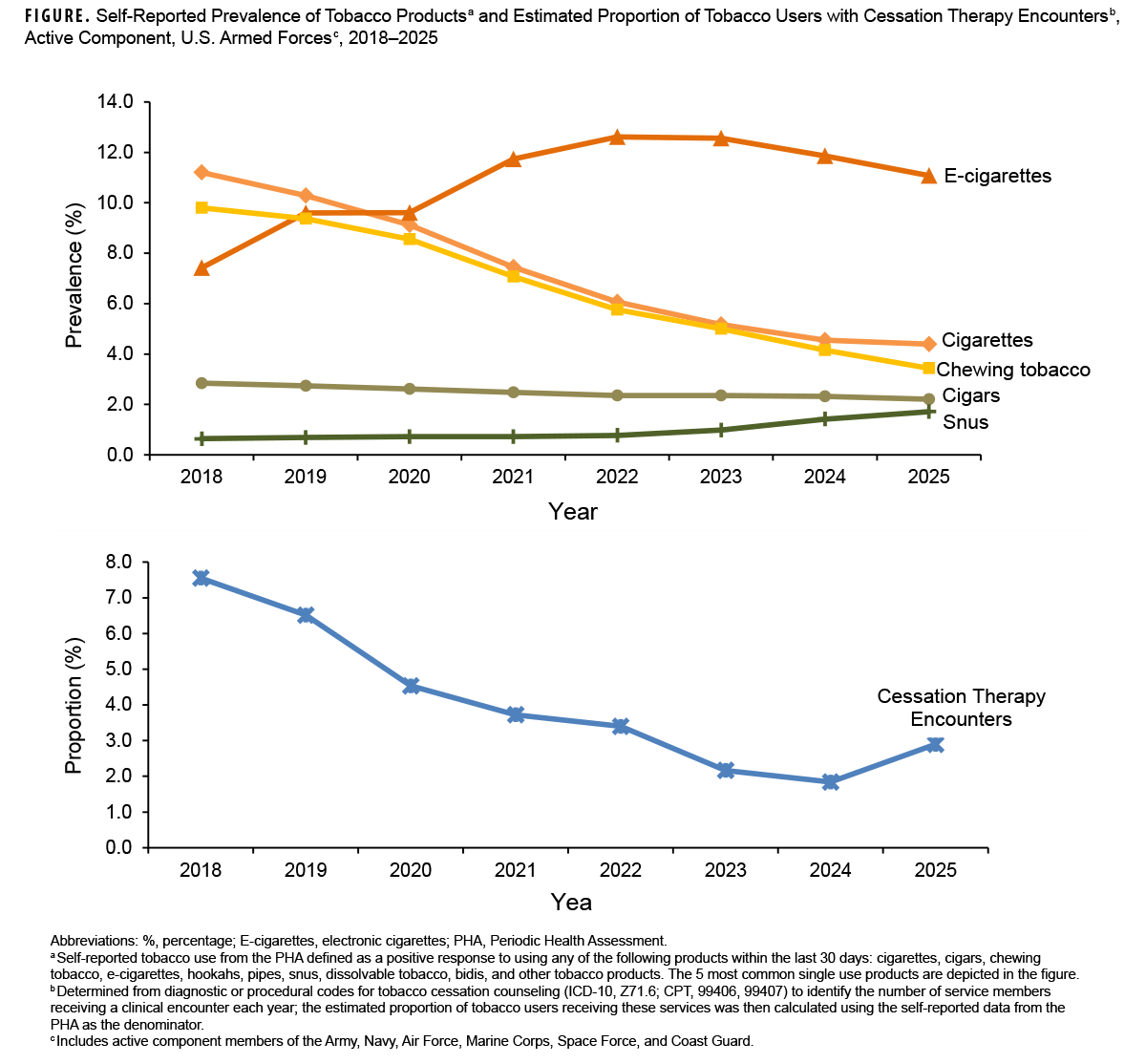
In contrast, e-cigarette use increased during the surveillance period, surpassing traditional cigarettes after 2020 and peaking in 2022 to become the most reported product. E-cigarette use nearly doubled between 2018 and 2023 in both the Army (7.4% to 14.6%) and Marine Corps (9.8% to 18.5%) (data not shown). Over the 8-year period, reported snus (tobacco pouch) use nearly tripled (0.6% to 1.7%), and dissolvable tobacco increased more than 17-fold, although its absolute prevalence remained low (0.04% to 0.70%) (data not shown).
Several methodological caveats should be considered when interpreting these data. Because this analysis relies strictly on structured CPT and diagnostic billing codes, it measures dedicated, timed counseling sessions rather than brief, point-of-care screenings. Additionally, this analysis does not include other critical components of cessation such as pharmacotherapy. The decline in documented counseling could indicate a shift in treatment approaches, with health care providers potentially focusing on medication-based therapies without separately-coded counseling sessions. Since this analysis employed population-level estimates rather than deterministic individual records, it could not verify that every individual in the numerator (i.e., clinical encounter) was represented in the denominator (i.e., self-reported PHA tobacco users). Consequently, the calculated proportions represent a population-level estimate of counseling services relative to estimated prevalence. Finally, the estimation of tobacco users from self-reported data may be under-estimated due to social desirability bias, as demonstrated in prior analyses.3
The discordant trends in clinical encounters for cessation counseling and e-cigarette use require additional study. Future analyses should integrate and investigate pharmacy data for cessation medications. Evaluating pharmacological records as well as clinical encounter trends will clarify whether the decline in coded encounters for counseling cessation reflects a genuine gap in care or a systemic shift toward medication-centric treatment models.
References
- Foxon F, Selya A, Gitchell J, Shiffman S. Increased e-cigarette use prevalence is associated with decreased smoking prevalence among US adults. Harm Reduct J. 2024;21(1):136. doi:10.1186/s12954-024-01056-0
- Patrick S, Boyle C, LaMorte D, Dore M. Tobacco use prevalence in the Military Health System: a retrospective study. Mil Med. 2024;189(11-12):e2632-e2637. doi:10.1093/milmed/usae208
- Rossi KR, Russell SJ, Mabila SL. Distribution of tobacco and nicotine use indicators from the Periodic Health Assessment and medical diagnostic codes among U.S. active component service members, 2023. MSMR. 2026;33(4):3-9. Accessed Oct. 15, 2026. https://www.health.mil/news/articles/2026/04/01/msmr-pha-icd-tobacco-nicotine-use
Authors’ Affiliation
Epidemiology and Analysis Branch, Armed Forces Health Surveillance Division, Public Health Directorate, Defense Health Agency, Silver Spring, MD: Ms. Rossi, Mr. Russell, Dr. Mabila
Disclaimer
The views expressed in this report reflect the results of research conducted by the authors and do not necessarily reflect official policy nor position of the Defense Health Agency, Department of War, or the U.S. Government.