Reportable medical events at Military Health System facilities through week 36, ending September 6, 2025

Image of ToC_Photo5. Reportable medical events are documented to monitor, control, and prevent the occurrence and spread of diseases.

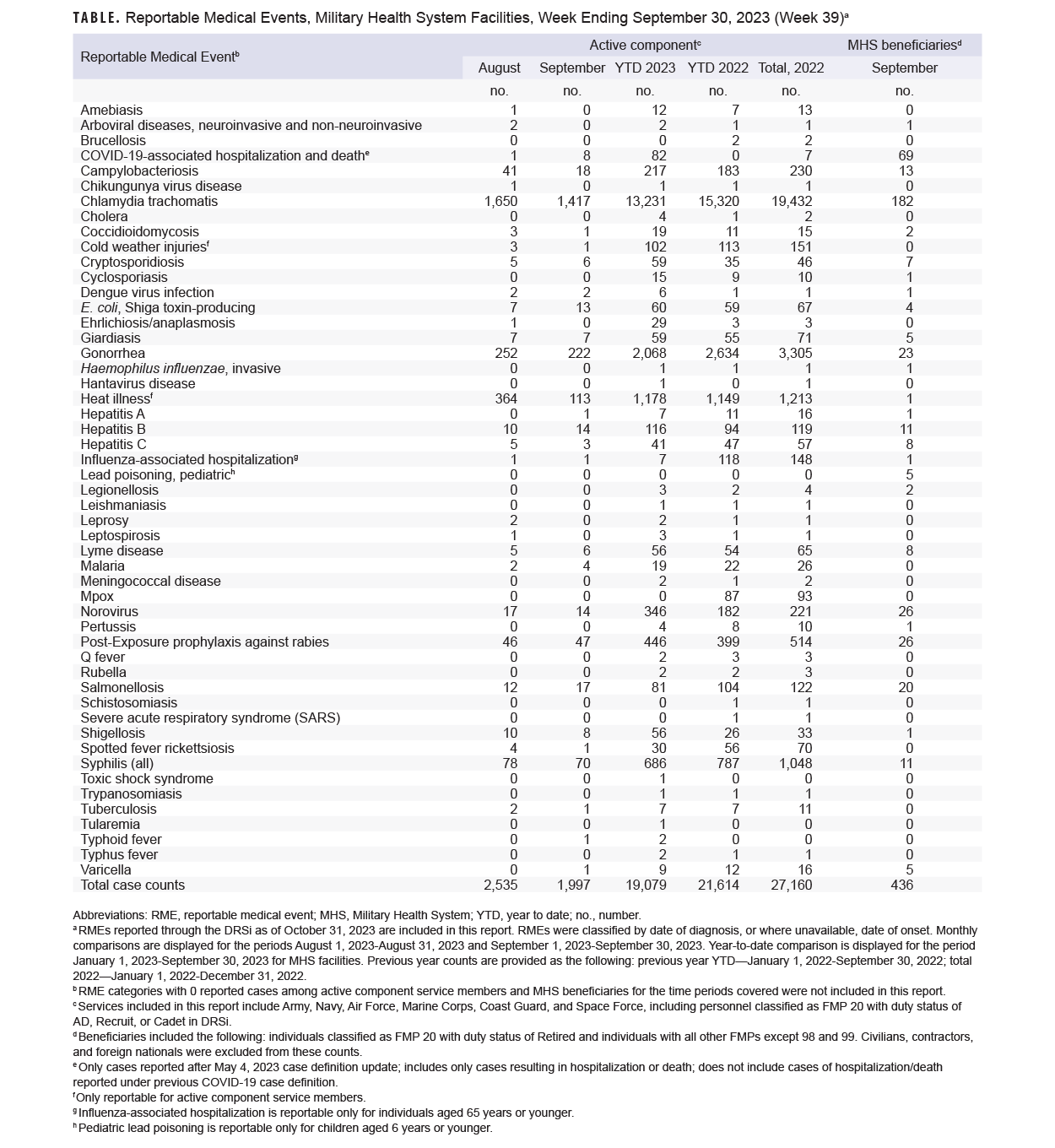
Reportable Medical Events (RMEs) are documented in the Disease Reporting System internet (DRSi) by health care providers and public health officials throughout the Military Health System (MHS) for monitoring, controlling, and preventing the occurrence and spread of diseases of public health interest or readiness importance. These reports are reviewed by each service’s public health surveillance hub. The DRSi collects reports on over 70 different RMEs, including infectious and non-infectious conditions, outbreak reports, STI risk surveys, and tuberculosis contact investigation reports. A complete list of RMEs is available in the 2022 Armed Forces Reportable Medical Events Guidelines and Case Definitions.1 Data reported in these tables are considered provisional and do not represent conclusive evidence until case reports are fully validated.
Total active component cases reported per week are displayed for the top 5 RMEs for the previous year. Each month, the graph is updated with the top 5 RMEs, and is presented with the current month’s (August 2025) top 5 RMEs, which may differ from previous months. COVID-19 is excluded from these graphs due to changes in reporting and case definition updates in 2023.
Top 5 Reportable Medical Events by Calendar Week, U.S. Active Component Service Members, September 8, 2024–September 6, 2025 This is a line graph with a logarithmic vertical axis, which tracks the number of weekly reported cases for the top five reportable medical events among active-duty U.S. service members from September 2024 to September 2025. The purpose is to visualize the trends and seasonality of Chlamydia, Gonorrhea, Heat Illness, Norovirus, and Syphilis. The graph clearly shows that Chlamydia is the most frequently reported event, with weekly cases typically in the hundreds. Heat illness demonstrates a strong seasonal pattern, with a significant peak in cases during the summer months and very few cases in the winter. Gonorrhea is the second most common sexually transmitted infection, while Norovirus and Syphilis are reported at lower rates.

For questions about this report, please contact the Disease Epidemiology Branch at the Defense Centers for Public Health–Aberdeen. Email: dha.apg.pub-health-a.mbx.disease-epidemiologyprogram13@health.mil

Authors’ Affiliation

Defense Health Agency, Disease Epidemiology Branch, Defense Centers for Public Health–Aberdeen

References

  1. Armed Forces Health Surveillance Division. Armed Forces Reportable Medical Events. Accessed Feb. 28, 2024. https://health.mil/reference-center/publications/2022/11/01/armed-forces-reportable-medical-events-guidelines 
  2. Defense Manpower Data Center. Department of Defense Active Duty Military Personnel by Rank/Grade of Service. Accessed Feb. 28, 2024. https://dwp.dmdc.osd.mil/dwp/app/dod-data-reports/workforce-reports 
  3. Defense Manpower Data Center. Armed Forces Strength Figures for January 31, 2023. Accessed Feb. 28, 2024. https://dwp.dmdc.osd.mil/dwp/app/dod-data-reports/workforce-reports 
  4. Navy Medicine. Surveillance and Reporting Tools–DRSI: Disease Reporting System Internet. Accessed Feb. 28, 2024. https://www.med.navy.mil/navy-marine-corps-public-health-center/preventive-medicine/program-and-policy-support/disease-surveillance/drsi

You also may be interested in...

Article
Jan 1, 2024

Brief Report: The Four Most Frequently Diagnosed Vector-borne Diseases Among Service Member and Non-Service Member Beneficiaries in the Geographic Combatant Commands, 2010–2022

This report provides linear trends of selected vector-borne diseases, over a 13-year surveillance period, among Armed Forces service and non-service member beneficiaries diagnosed at installations within the Northern Command (NORTHCOM), Africa Command (AFRICOM), Central Command (CENTCOM), European Command (EUCOM), Indo-Pacific Command (INDOPACOM), or ...

Article
Jan 1, 2024

Ivermectin Prescription Fill Rates Among U.S. Military Members During the Coronavirus Disease 2019 (COVID-19) Pandemic

This report describes ivermectin prescription fill rates among U.S. active component service members over time during the early phases of the COVID-19 pandemic. Ivermectin prescription fill rates increased among active component service members early in the COVID-19 pandemic when misinformation about the effectiveness of ivermectin for prevention and ...

Article
Jan 1, 2024

Reportable Medical Events at Military Health System Facilities Through Week 48, Ending November 30, 2023

Each month the MSMR publishes an update of reportable medical events documented in the Disease Reporting System internet by health care providers and public health officials throughout the Military Health System, for monitoring, controlling, and preventing the occurrence and spread of diseases of public health interest or readiness importance.

Refine your search