Surveillance snapshot: Mid-year populations by sex, age, and race and ethnicity of U.S. active component service members, 2023–2025

Image of Photo3_ToC_Snapshotmidyearpopulations_7048784. The minimum and maximum mid-year populations of U.S. active component service members ranged from 1,063,862 to 1,085,521 men and 230,260 to 240,065 women from 2023 to 2025.

This Surveillance Snapshot describes the mid-year population for active component service members (ACSMs) of the U.S. Army, Navy, Air Force, Marine Corps, Space Force, and Coast Guard from 2023 to 2025, stratified by age, sex, and race and ethnicity. Population counts were obtained from June of each calendar year using personnel data from the Defense Manpower Data Center (DMDC) maintained in the Defense Medical Surveillance System (DMSS). Counts and percentages were stratified by sex, age group, and race and ethnicity.

In DMSS, race and ethnicity are categorized as non-Hispanic White, non-Hispanic Black, Hispanic, Asian/Pacific Islander, and American Indian/Alaskan Native, and Other. Both sex and race and ethnicity are self-reported by individual service members. As of 2021, the values for Asian/Pacific Islander and American Indian/Alaskan Native are not populated in DMSS for the Air Force and Coast Guard, and these 2 groups have been included in the ‘other’ category for this report.

The minimum and maximum mid-year populations of ACSMs ranged from 1,063,862 to 1,085,521 among men and 230,260 to 240,065 among women during the surveillance period. Demographic shifts among ACSMs varied by age and sex. In 2025, 81.8% of the active component was comprised of men, and 18.2% was comprised of women (Table). Stratified by age, the proportion of women was highest among the younger than age 20 years group (21.3%) and lowest in the ages 50-54 years group (15.1%).
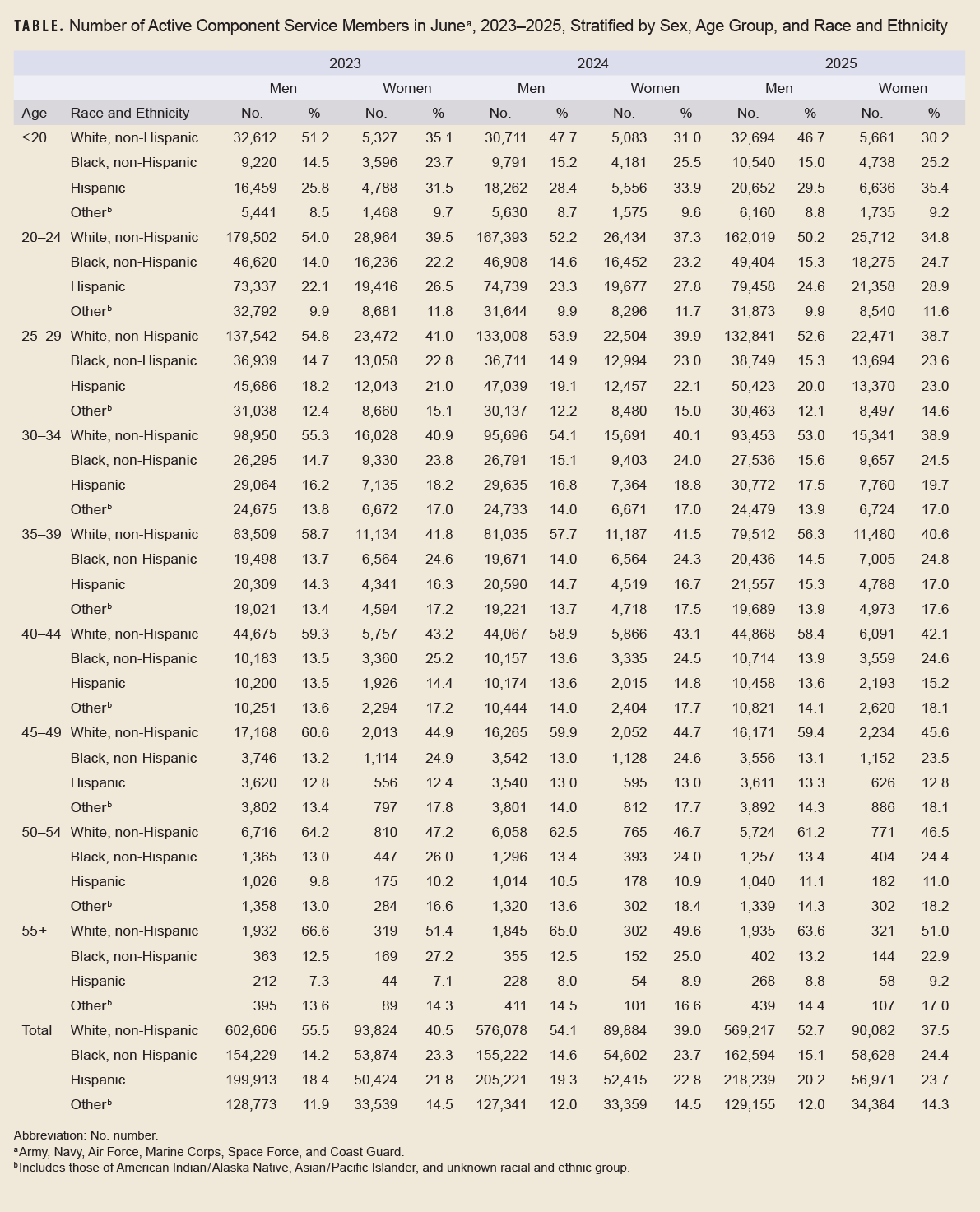
Overall, while non-Hispanic White service members represented the largest proportion by race and ethnicity in 2025, that proportion declined over the surveillance period. The proportion of Hispanic service members increased throughout the surveillance period, continuing a recent trend.1 The greatest demographic shifts are seen in the younger than age 20 years group, with the greatest percent increase in numbers among service members identifying as Black, non-Hispanic, Hispanic, and ‘other’ for both sexes. Among female service members younger than age 20 years, those identifying as Hispanic constituted the largest group (35.4%) in 2025. Similar trends are seen among male service members younger than age 20 years, where non-Hispanic White male service members represented less than half of men in that age group (46.7%), and the proportion of Hispanic men has increased since 2023 (29.5%). Among older age groups, demographic shifts are less pronounced. These data can be used to provide additional context for health surveillance analyses for U.S. ACSMs.

Reference

  1. McQuistan A, Dreyer E, Mabila S. Mid-year populations by sex, age, and race and ethnicity of active component service members of the U.S. Armed Forces, 2018–2022. MSMR. 2023;30(12):12. Accessed Feb. 26, 2026. https://health.mil/reference-center/reports/2023/12/01/msmr-vol-30-no-12-dec-2023

You also may be interested in...

Report
Jan. 1, 2023

MSMR Vol. 30 No. 1 - January 2023

.PDF | 1.22 MB

A monthly publication of the Armed Forces Health Surveillance Division. This issue of the peer-reviewed journal contains the following articles: Incidence and management of chronic insomnia, active component, U.S. Armed Forces, 2012 to 2021; Changes in the prevalence of overweight and obesity and in the incidence of prediabetes and type 2 diabetes ...

Report
Dec. 1, 2022

MSMR Vol. 29 No. 12 - December 2022

.PDF | 2.22 MB

A monthly publication of the Armed Forces Health Surveillance Division. This issue of the peer-reviewed journal contains the following articles: Surveillance trends for SARS-CoV-2 and other respiratory pathogens among U.S. Military Health System Beneficiaries, Sept. 27, 2020 – Oct. 2,2021; Establishment of SARS-CoV-2 genomic surveillance within the ...

Report
Nov. 1, 2022

MSMR Vol. 29 No. 11 - November 2022

.PDF | 1.30 MB

A monthly publication of the Armed Forces Health Surveillance Division. This issue of the peer-reviewed journal contains the following articles: Surveillance trends for SARS-CoV-2 and other respiratory pathogens among U.S. Military Health System Beneficiaries, Sept. 27, 2020 – Oct. 2,2021; Establishment of SARS-CoV-2 genomic surveillance within the ...

Report
Oct. 1, 2022

MSMR Vol. 29 No. 10 - October 2022

.PDF | 1.41 MB

A monthly publication of the Armed Forces Health Surveillance Division. This issue of the peer-reviewed journal contains the following articles: Surveillance trends for SARS-CoV-2 and other respiratory pathogens among U.S. Military Health System Beneficiaries, Sept. 27, 2020 – Oct. 2,2021; Establishment of SARS-CoV-2 genomic surveillance within the ...

Report
Sept. 1, 2022

MSMR Vol. 29 No. 09 - September 2022

.PDF | 2.12 MB

A monthly publication of the Armed Forces Health Surveillance Division. This issue of the peer-reviewed journal contains the following articles: Surveillance trends for SARS-CoV-2 and other respiratory pathogens among U.S. Military Health System Beneficiaries, Sept. 27, 2020 – Oct. 2,2021; Establishment of SARS-CoV-2 genomic surveillance within the ...

Report
Aug. 1, 2022

MSMR Vol. 29 No. 08 - August 2022

.PDF | 822.83 KB

A monthly publication of the Armed Forces Health Surveillance Division. This issue of the peer-reviewed journal contains the following articles: Surveillance trends for SARS-CoV-2 and other respiratory pathogens among U.S. Military Health System Beneficiaries, Sept. 27, 2020 – Oct. 2,2021; Establishment of SARS-CoV-2 genomic surveillance within the ...

Report
July 1, 2022

MSMR Vol. 29 No. 07 - July 2022

.PDF | 1.67 MB

A monthly publication of the Armed Forces Health Surveillance Division. This issue of the peer-reviewed journal contains the following articles: Surveillance trends for SARS-CoV-2 and other respiratory pathogens among U.S. Military Health System Beneficiaries, Sept. 27, 2020 – Oct. 2,2021; Establishment of SARS-CoV-2 genomic surveillance within the ...

Fact Sheet
March 30, 2017

Demographic and Military Traits of Service Members Diagnosed as Traumatic Brain Injury Cases

.PDF | 283.00 KB

This fact sheet provides details on the demographic and military traits of service members diagnosed as traumatic brain injury (TBI) cases during a 16-year surveillance period from 2001 through 2016, a total of 276,858 active component service members received first-time diagnoses of TBI - a structural alteration of the brain or physiological ...

Fact Sheet
March 30, 2017

Rhabdomyolysis by Location, Active Component, U.S. Armed Forces, 2012-2016 Fact Sheet

.PDF | 313.80 KB

This fact sheet provides details on Rhabdomyolysis by location for active component, U.S. Armed Forces during a five-year surveillance period from 2012 through 2016. The medical treatment facilities at nine installations diagnosed at least 50 cases each and, together approximately half (49.9%) of all diagnosed cases.

Fact Sheet
March 30, 2017

Heat Illnesses by Location, Active Component, U.S. Armed Forces, 2012-2016 Fact Sheet

.PDF | 267.04 KB

This fact sheet provides details on heat illnesses by location during a five-year surveillance period from 2012 through 2016. 11,967 heat-related illnesses were diagnosed at more than 250 military installations and geographic locations worldwide. Three Army Installations accounted for close to one-third of all heat illnesses during the period.

Refine your search