This year, the Military Health System is celebrating 250 years of America by recognizing the Military Medicine’s enduring history of innovation and impact to the warfighter. Please join the Military Medicine 250 campaign!
As the first surgeon general of the U.S. Air Force, Maj. Gen. Malcolm C. Grow charted a course that defined modern military medicine for future airmen. His leadership and innovation built the foundation of the Air Force Medical Service, and the Malcolm Grow Medical Clinics and Surgery Center honors his namesake by delivering exceptional military health care today.
Grow had already proven himself as a physician, researcher, and leader long before the U.S. Air Force became a separate military department in 1947. During World War I and World War II, he saw firsthand the unique physical and psychological stresses flight crews faced — shaping his belief, and dedication to ensuring medicine meets warfighters where they serve, whether air, land, or sea.
‘Sudden decision’ led to a military career
After graduating from Jefferson Medical School in 1909, Grow began to establish himself as a physician in Philadelphia — but he yearned for more.
In the 1910s, a discussion with friend Dr. Edward Egbert, chief surgeon of an American Red Cross hospital in what is present day Ukraine, led Grow to seek a medical commission to support the World War I-era Russian Army, allied with France and Great Britain, where qualified doctors were needed. Egbert told him that by joining the fight, "you will gain experience in surgery in a few months that you could not get otherwise in years and years of private practice,” Grow recounted in his biographical writing. “I made a sudden decision. I resolved to go to Russia.”
Then in February 1917, he was appointed a captain in the U.S. Army’s Medical Reserve and served in the American Expeditionary Forces in Europe in 1918-19. He was commissioned into the Regular Army Medical Corps in 1920. He later served as chief flight surgeon for the Army Air Corps from 1934 to 1939.
During this time, in 1935, Grow cofounded with Harry G. Armstrong the Physiological Research Unit at Wright Field in Ohio. The laboratory became the U.S. Air Force’s leading center for creating tools to address aviation health risks.
Spearheading protective innovations for unique challenges
As flight surgeon of the famed Alaskan Flight in 1934, Grow provided crucial medical care to members of the mission. The historic flight, covering 8,290 miles round-trip from Bolling Field in Washington, D.C., to Fairbanks, Alaska, had three primary objectives: to demonstrate the feasibility of deploying air forces to Alaska in times of need; to photograph landing sites suitable for frontier defense; and to test the possibilities of rapid and large-scale photomapping of terrain. The flight proved that Air Corps pilots, under the supervision of medical personnel, could navigate over long distances.
During World War II, Grow oversaw treatment of service members injured in air combat — confronting the unique dangers of aerial warfare — and helped design gear to save lives. As the Eighth Air Force Surgeon (1942-44) and the U.S. Strategic Air Forces in Europe Surgeon (1944-45), Grow saw crews suffering frostbite, oxygen loss, and severe injuries at high altitudes. He worked with engineers to design and procure heated clothing and body armor, innovations that saved countless lives.
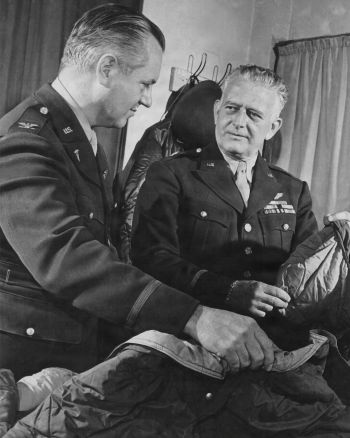 Col. Herbert B. Wright (left), the Chief of Professional Services, U.S. Army 8th Air Force and Brig. Gen. Malcolm C. Grow, at the time, Surgeon of the U.S. Army 8th Air Force, examine a heating bag Grow helped develop to keep fliers warm during high-altitude missions. (Photo courtesy of Air Force Medical Service History Office)
Honored for dedication to airmen’s health and readiness
In July 1943, he was awarded the Legion of Merit for his work developing body armor for combat flight crews. In May 1944, he received the Distinguished Service Medal for innovations in flight crew protective devices and psychiatric support for combat airmen.
When the U.S. Air Force officially established in 1947, Grow argued that its medical service must do the same. “Air medicine must be built around the mission of airpower,” he wrote. His conviction helped establish the Air Force Medical Service, and he became the first surgeon general of the U.S. Air Force where he advocated for a medical structure oriented to the unique needs of air warfare.
Grow retired from service with the rank of major general on Nov. 30, 1949.
Malcolm Grow Medical Clinics and Surgery Center at Joint Base Andrews, Maryland, honors his legacy by caring for service members, families, and retirees from across the National Capital Region, and supports readiness across the U.S. Air Force’s global mission — a mission grounded in Grow’s imprint.
The center features an en route patient staging facility to provide care to critically injured patients who require stabilization, advanced trauma resuscitation, and surgical intervention before transport to a care facility. The hospital also has the only full-time acupuncture center in the U.S. Air Force.
At Malcolm Grow Medical Clinics and Surgery Center in 2023, the 316th Wing Medical Group gathered to commemorate Grow’s 136th birthday where leaders highlighted his lasting legacy.
“As we celebrate Grow’s birthday, let us reflect on his remarkable achievements and the impact he has made on the Air Force and medical community,” said the group’s commander at the time, Col. Robert Corby. “His legacy serves as an inspiration to all of us, reminding us of the importance of dedication, innovation, and compassion for our own lives and careers.”