This section describes the eight alert incidents found on the Fox vehicle tapes provided by the soldier. Sections from both the Edgewood and PAC tapes have been reproduced to assist the reader in understanding the analyses of the ground war alerts that follow. The Fox vehicle and the crewmen addressed in this case narrative were originally part of a unit of three Fox vehicles called Section 7 of the 25th Chemical Reconnaissance Company, 8th Infantry Division, stationed in Germany. Before their departure to Saudi Arabia in November 1990, the crew received their Fox vehicle training from the German NBC and Self Protection School. On December 26, 1990, this crew was assigned to support the operations of the 24th ID, more specifically the 2nd Squadron, 4th Cavalry Regiment (2/4 CAV) and, subsequently, the Scout Platoon, 3rd Battalion, 7th Infantry Regiment, 1st Brigade, 24th Infantry Division (3/7 Infantry).[45]
1. Pre-ground War Alerts
During this pre-ground phase of the conflict, the 2/4 CAV was the screening force and acted as the 24th ID’s first line of defense against an Iraqi ground force incursion into Saudi Arabia. As such, the nine platoons of 2/4 CAV were deployed inside the Saudi border along a 70-kilometer screenline in front of the 24th ID main force. The three Fox vehicles served as chemical warfare agent monitors along this screenline.[46]
According to the Fox vehicle commander, before the ground war, the Fox crew conducted various training exercises on the MM-1, including confidence checks using test chemicals. They also conducted cross-training exercises, so every crewmember would know how to operate the MM-1. Additionally, they demonstrated to other units how the Fox vehicle worked, hoping that the familiarization with their foreign-looking vehicle would cut down on possible friendly-fire incidents. During this time, the Fox vehicle commander noted no unusual activities.[47]
From January 17 to February 24, 1991 (the first day of the ground war) the 2/4 CAV commander stated that nothing unusual happened to his unit. Occasionally the squadron NBC officer told him about an M8A1 registering a false alarm. The 2/4 CAV commander was never notified about any Fox alert or other positive chemical warfare agent alerts. For this reason, he never ordered any of his subordinate units to a higher level of protection, known as mission oriented protective posture,[48] in response to possible chemical warfare agent presence. Additionally, he does not know of any of his platoons being ordered to a higher protection level.[49] The 2/4 CAV squadron surgeon recorded no casualties of any type, including chemical warfare agent casualties, during this period. The only casualties he recalled were a few conventional munitions casualties (non-nuclear, chemical, or biological), which occurred during the ground war and post-ground-war period. Additionally, no personnel in the regiment reported any odd symptoms at sick call that would have indicated a chemical warfare agent exposure.[50]
Figure 3 shows the general location of four alerts recorded on the Fox tapes. The timeline of pre-ground war alerts (Figure 4) provides an overview of the dates and times of the Fox alerts discussed below in Sub-sections a. through d. All the alerts on the Fox tapes registered at low ion intensity levels (under 2.0) and in their analysis of the alerts, CBDCOM’s Fox vehicle experts quoted the manufacturer of the MM-1, Bruker-Franzen: "… [I]t is highly unlikely to get true alerts at so low a response level."[51]
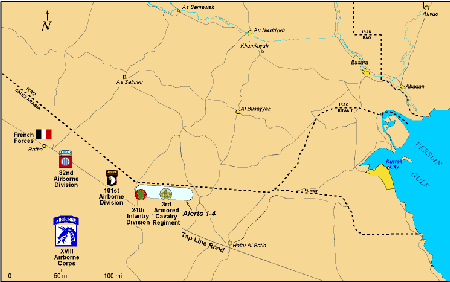 Figure 3. Approximate locations of pre-ground war Fox alerts (February 1-14, 1991)
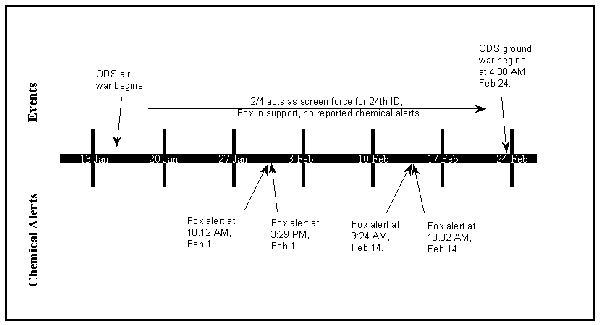 Figure 4. Timeline of pre-ground war alerts (February 1-14, 1991)
a. Alert 1: February 1, 1991, 10:12 AM[52]
At 10:12 AM, the MM-1 alerted for the possible presence of phosgene oxime (shown as PHOSGENOX (CX) on the Fox tape) and tabun (Figure 5). The ion intensity levels for the agents were 1.7 and 1.9, respectively.
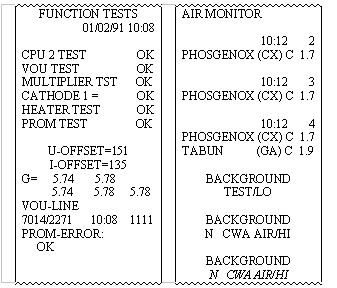 Figure 5. Fox tape, February 1, 1991
Analysis of Alert 1
When CBDCOM evaluated the tapes in 1993, they quoted the technical experts at Bruker-Franzen who thought it unlikely that a true alert would come from such a low response level as shown in the tapes.[53] It is not surprising that spectra were not taken since MM-1 operators were trained to perform spectra in response to alerts with ion intensity levels of four and above.[54] The tapes indicate that before this alert, the crew ran function tests which verified that all components of the MM-1 were fully operational (indicated by the OK after each test). However, the Fox crew did not perform confidence checks, as called for in the start-up procedures, to further confirm the operational status of the MM-1.[55]
After the tabun alert, the MM-1 operator changed the sampling method to Test/Lo, then switched it again to Air/Hi. There is no apparent reason for this action because the Test/Lo method should only be used to check the proper functioning of the MM-1 during initial start-up. According to CBDCOM’s analysis of this alert, "[S]ince no more [alerts] occurred after [a] new background was taken [when the operator changed methods], these are attributable to the sampling wheels off-gassing."[56] Off-gassing refers to the MM-1 falsely identifying vapors from silicone sampling wheels as a chemical warfare agent. This problem was identified and corrected after the war. Additionally, at the time of the alerts, according to the vehicle’s location reporting system (shown on the tape to the left of the 10:08 time notation), the vehicle had not moved from its original start-up location.[57] This means the Fox was in the garrison area of the 2/4 CAV and interviews show that this unit reported no chemical incidents and that no chemical warfare agent symptoms were reported to unprotected troops.[58]
Since the end of the Gulf War, the United Nations Special Commission (UNSCOM) has inspected, inventoried, and destroyed Iraqi weapons of mass destruction, including chemical warfare agents and munitions filled with chemical warfare agents. During the inspection process, UNSCOM never found phosgene oxime in Iraq’s chemical warfare agent inventory. If Iraq didn’t produce or weaponize phosgene oxime, it could not have been used against Coalition forces. Iraq abandoned tabun (GA) in the mid-1980s and UNSCOM and the Central Intelligence Agency (CIA) reported UNSCOM found only two aerial bombs containing tabun, and these were found at Al Muthanna, they were not deployed into other bases,[59] including areas entered by US forces. The only method for Iraq to deliver these aerial bombs was by aircraft and this did not happen because Iraq did not fly ground attack sorties after January 25, 1991.[60] At the time of the phosgene oxime and tabun alerts, the Fox vehicle was not under attack. Specifically, no Iraqi weapons system that could deliver chemical weapons (aircraft, artillery, or missile) engaged this unit at the time of this incident. These operational insights, combined with the information we know about Iraq’s chemical warfare agent inventory and the analysis of the Fox tapes, lead us to state that chemical warfare agents were not present.
b. Alert 2: February 1, 1991, 3:29 PM
Approximately five hours after the first alert, the MM-1 alerted again, at 3:29 PM (15:29), for tabun at a 1.9 ion intensity level (Figure 6).
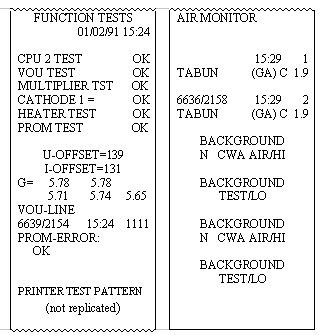 Figure 6. Fox tape, February 1, 1991
Analysis of Alert 2
This alert occurred five minutes after the function tests were performed, and according to the vehicle’s location reporting system at the time of this alert, the vehicle had not traveled far from its initial starting location. Subsequent alerts did not occur when the MM-1 operator switched the detection method back and forth between Air/Hi and Test/Lo. Again, it is not apparent why the operator changed the method to Test/Lo. The ion intensity level was very low, and CBDCOM came to the same conclusion about this alert as it did about Alert 1 above—namely, that off-gassing caused the alert.[61]
Finally, as described in the analysis section of Alert 1, UNSCOM and CIA assess that there were no deployed tabun weapons.[62] At the time of the tabun alerts, the Fox vehicle was not under attack and a delivery means for these agents was not identified. Since Iraqi aircraft did not fly ground attack sorties after January 25, 1991,[63] it was not possible for tabun to be used against Coalition forces and then detected by the Fox vehicle.
c. Alert 3: February 14, 1991, 9:24 AM
Almost two weeks later on February 14th, the Fox vehicle alerted for the presence of HT mustard at 1.9 ion intensity level(Figure 7).
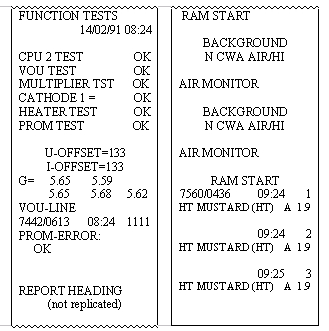 Figure 7. Fox tape, February 14, 1991
Analysis of Alert 3
One hour before this alert, a function test confirmed that the MM-1’s electronic components were properly functioning (indicated by "OK" after each test), but the crew did not perform any confidence checks to ensure that the MM-1 was otherwise operating properly. Some time after the function test at 8:24 AM, the MM-1 was manually turned off and turned back on at 9:24 AM (indicated by the "RAM START" printed on the tape). When the MM-1 was turned back on, the crew did not perform new function tests and confidence checks to verify that the MM-1 was fully operational before receiving alerts for HT.[64]
Although the MM-1 has a limited capability to detect chemical warfare agents in the air, the Fox vehicle sometimes was used for vapor detection during the war, noted by an "A" printed on the tape to the left of the ion intensity. However, it is not optimized for this mission, nor is its alerting capability in this method of operation as good as that of other chemical warfare agent detectors.[65] In this incident, the Fox was sampling the air and was not using the wheels to search for liquid contamination on the ground. The "A" on the tape before the ion intensity level notes that the wheels are not being used.
UNSCOM inspectors did not find HT mustard in Iraq’s inventory. They did find HD mustard that contained trace amounts of HT as a manufacturing byproduct.[66] The only ground delivery system that Iraq had for mustard (HD) was 155mm artillery,[67] but the 2/4 CAV received no artillery fire while they were the screening force before the start of the ground war.[68]
According to a US Army field manual, HT’s "… low volatility makes effective vapor concentrations in the field difficult to obtain."[69] Since the Fox was sampling the air and not using the sampling wheels, it is doubtful the MM-1 would detect this small presence of HT had it been present.[70] Additionally, the CBDCOM experts said they "would expect a simultaneous detection of HD [mustard] since it is the more volatile component of HT [mustard]; HD is not evident in any of the HT detections on this tape." It is not unusual for HD mustard to have impurities that can result in small quantities of HT and HQ. HD is more volatile or quicker to vaporize than both HT and HQ and an alert for either of these agents also normally would include an alert for HD.[71] Finally, CBDCOM noted that the low ion intensity level casts additional doubt on the validity of this alarm.[72] Because the unit was not under attack, HT was not in Iraq’s inventory, and given the difficulty of detecting HT vapor, this alert of HT mustard is not valid.
d. Alert 4: February 14, 1991, 10:02 AM
A little over 30 minutes later on February 14th, at 10:02 AM, the MM-1 alerted for phosgene oxime at a low ion intensity level. Three minutes before this alert, the MM-1 operator performed function tests that identified problems with some of the electronic components (noted by the "N" and "W"), indicating that the MM-1 was not fully operational and not able to make valid detections for chemical warfare agents (Figure 8).[73]
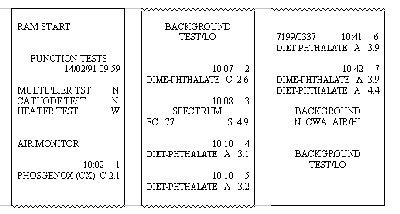 Figure 8. Fox tape, February 14, 1991
After the phosgene oxime alert, the operator changed the sampling method to Test/Lo, and at 10:07 AM, the MM-1 registered an alert for dimethylphthalate, a confidence check simulant. One minute after the dimethylphthalate alert, the MM-1 operator performed a spectrum, which identified FC 77, a calibration gas. The Fox tape indicates subsequent alerts for dimethylphthalate and diethylphthalate (another confidence check simulant) from 10:10 AM to 10:42 AM, but the operator took no additional measures since these are the test simulants, not chemical warfare agents.[74]
Analysis of Alert 4
The function tests before the phosgene oxime alert indicated problems with the MM-1’s electronic components. Unless the operator gets an "OK" reading for each component tested, the MM-1 will not operate accurately.[75] The "N" that appears after both the multiplier and cathode tests indicates that the tests could not be performed because either the module to be tested was not present or it was manually turned off. The "W" displayed after the heater test warned the MM-1 operator that the MM-1 was operational, but that the tested modules may have been outside the control limits (e.g., the MM-1 may not have been operating long enough to properly heat the probe). When the MM-1 displayed these warnings, the function tests should have been repeated until an "OK" reading appeared for all components tested.[76]
When the MM-1 operator switched the MM-1 to the Test/Lo method minutes after the initial alert, the MM-1 showed that the confidence check simulant dimethylphthalate was present in the probe at a level below the required ion intensity level (registering only 2.6 instead of the required 5.0 or above).[77] Since the function tests showed that certain MM-1 electrical components were not ready and the confidence check did not reach the desired ion intensity level, it is safe to say the MM-1 was not fully functional at the time of the phosgene oxime alert and probably was responding to remaining simulants that had not been purged from the system. In fact, the operator probably introduced the simulant for the confidence check before the MM-1 was ready and before switching to the Test/Lo method, thereby yielding the false positive for phosgene oxime. The spectrum confirmed phosgene oxime was not present.[78] Finally, as described in the analysis of Alert 1, although Iraq researched phosgene oxime as a chemical warfare agent, it did not produce or weaponize phosgene oxime, so it could not have been used against Coalition troops.[79]
2. Ground War Alerts
Several days before the ground war started, units subordinate to the main maneuver brigades of the 24th ID replaced the 2/4 Cavalry Regiment as the screening force. This particular Fox was reassigned to the Scout Platoon, 3/7 Infantry of the 24th ID, which probably deployed over the Iraq-Saudi border shortly before the start of the ground war.[80]
At the start of the ground war (February 24, 1991), the 24th ID, shown in Figure 9, was located on the left flank of the Coalition forces, with the 3rd Armored Cavalry Regiment to the right and the 101st Airborne to the left. The 24th ID attacked into Iraq three brigades abreast with the division cavalry squadron conducting reconnaissance and protection operations to the front. The division rapidly advanced to its objectives, maintaining speeds of 25 to 30 miles an hour.[81] The Division’s main objective was to cross Iraq’s border, link up with the 101st Airborne, cut Highway 8 by blocking it with armor, and then turn east where it was to destroy Iraq’s forces trapped in Kuwait or eastern Iraq.[82] During these operations, the 24th ID came within sight of the Khamisiyah ammunition supply point, which according to post-war UNSCOM investigations contained chemical warfare munitions. However, the 24th ID did not enter the Khamisiyah ammunition supply point.[83]
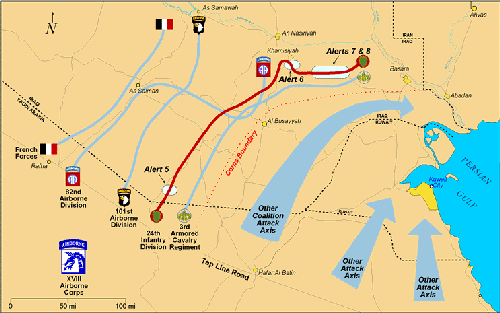 Figure 9. Approximate locations of ground war Fox alerts
Although the 24th ID covered much ground during the ground war, fighting was sporadic. The 52 men of the Scout Platoon, 3/7 Infantry did not suffer any casualties during the conflict and the commander specifically remembers no chemical incidents.[84] The entire 1st Brigade to which the 3/7 Infantry Battalion was attached suffered one conventional battle casualty and one reported toothache.[85] The platoon leader and the battalion operations officer were never informed of a Fox vehicle alert and at no time did the Scout Platoon, 3/7 Infantry, go to the maximum mission oriented protective posture.[86] During the ground war, the Scout Platoon, 3/7 Infantry, Fox was used as an on-the-move vapor detector.[87]
Sections from both the Edgewood and PAC tapes have been used to provide a more complete picture of the four ground war alerts. To view all segments of both copies please refer to the side-by-side comparison of the Edgewood tapes and the PAC tapes in Tab E. The timeline of ground war alerts (Figure 10) provides an overview of the dates and times of the Fox alerts discussed in Sub-sections a. through d. that follow.
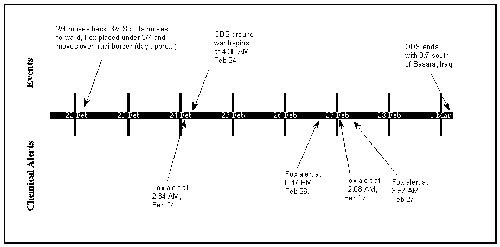 Figure 10. Timeline of ground war alerts (February 24 - March 1, 1991)
a. Alert 5: February 24, 1991, 2:34 AM
At 2:34 AM, on February 24, 1991, the MM-1 alerted for HT mustard at 1.9 ion intensity. After this alert, the MM-1 operator switched the sampling method several times between Air/Hi and Surface/Lo and no subsequent alerts occurred (Figure 11).
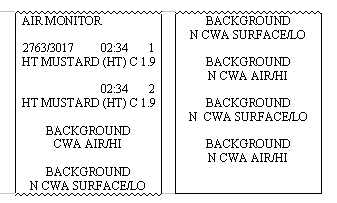 Figure 11. Fox tape, February 24, 1991
Analysis of Alert 5
Although this incident occurred about 90 minutes before the ground war officially began at 4:00 AM,[88] investigators consider this a ground war alert because the Scout Platoon, 3/7 Infantry had officially begun its ground war mission.[89]
The recommended speed of the Fox while using the wheels to sample is 8 to 12 miles per hour. Use of the wheels in sampling is noted on the MM-1 tape by the use of a "C." There are times when the MM-1 will improperly indicate that the wheels are being used.[90] Although some of the Fox tapes from the ground war, including this incident, indicate the sampling wheels were in use at the time of the alerts, according to an interview with the MM-1 operator, all the readings during the ground war were taken using the Air/Hi method. He stated that the task force to which the Fox was assigned often moved too fast to use the sampling wheels.[91] As discussed in the analysis of Alert 3, Air/Hi alerts are suspect because the MM-1 in the Fox vehicle is not well suited to act as a vapor detector.[92]
As with Alert 3, UNSCOM inspectors did not find HT mustard in Iraq’s inventory, although the impure HD mustard found contained trace amounts of HT as a byproduct. The only likely means of delivery for any type of mustard would have been 155mm artillery, and Iraq did not fire on the Scout Platoon, 3/7 Infantry, at this time.[93,94] Given the low volatility of HT mustard, an obvious liquid source for the alert would be expected and the Fox commander recalls no attack that would have provided such a chemical warfare agent source.[95,96] There is also an absence of HD mustard, which is the more volatile component of HT and would be expected to be identified in the same sample. Finally, as in the previous alerts, the low ion intensity level of this alert casts additional doubt on its validity. For these reasons, this alert for HT mustard was not valid.
b. Alert 6: February 26, 1991, 8:47 PM
Two days later at 10:58 AM on February 26, the MM-1 operator took the first of three full spectra even though the MM-1 did not register an alarm (Figure 12). Two of the three spectra produced "unknown" readings. A print-out of all the spectra (not replicated in Figure 12 but shown in Tab E) indicated that the unknown compounds comprised air mixed with some residual calibration gas (FC 77). These spectra were taken in the surface monitor mode. Several hours later at 8:47 PM (20:47) the MM-1 alerted for the nerve agent VX, registering 1.8 ion intensity level. From the tapes it appears that the MM-1 operator did not perform a spectrum at this time and the MM-1 did not register any subsequent alerts. The next action recorded on the tape is more than three hours later (12:07 AM, 00:07) and many kilometers away when the MM-1 operator performed a spectrum that showed an unknown substance.
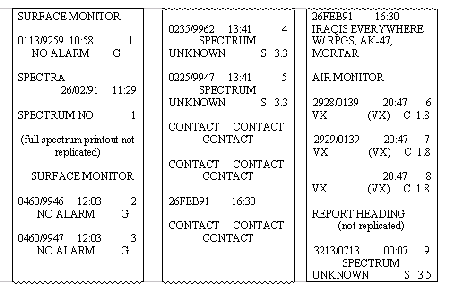 Figure 12. Fox tape, February 26, 1991
Analysis of Alert 6
From the time that the MM-1 operator performed the first spectrum at 11:29 AM to the time that the VX alert occurred at 8:47 PM (about 9 hours and 30 minutes), the MM-1 probe was never cleaned by running a temperature program, which means that the probe was probably contaminated and thus prone to a false alert or alarm.[97] Additionally, four hours before the VX alert, the Fox was engaged with Iraqi troops (note in Figure 12 the operator’s personal commentary: "CONTACT…CONTACT…CONTACT IRAQIS EVERYWHERE"). There are no reports of chemical warfare agents being used during this encounter, and no reported casualties.[98] Fumes from conventional explosives (non-nuclear, chemical, or biological) that may have been used in this encounter are a common interferent that could cause the Fox to issue a false alert or alarm.[99] Like all the Fox crews in the Gulf, this crew had not been trained to operate the vehicle in the surface monitor detection mode.[100]
UNSCOM was unable to fully account for Iraq’s VX production. Although UNSCOM found no VX-filled munitions or agents during the first four years of inspections, Iraq admitted in 1995 that it produced 1.8 tons of VX before abandoning this production program in 1990 in favor of sarin and cyclosarin.[101] According to the CIA expert on Iraq’s chemical warfare program, Iraq admitted to filling three aerial bombs with VX to test storage life. Additionally, UNSCOM detected VX on three warheads for Iraq’s Scud variant.[102] Since Iraq’s aircraft did not fly ground attack sorties after January 25, 1991, and Iraq had no deployed VX-filled weapons, it was not possible for VX to be delivered by aircraft against Coalition forces at this date.[103] Similarly, the last Scud launch of any kind during the war occurred 18 hours before the VX alert. Furthermore, this Scud landed near Doha, Qatar, far from the location of this alert.[104] Like HT mustard, VX is a liquid that does not easily vaporize. For this reason, the Fox vehicle has almost no capability to detect VX as a vapor.[105]
c. Alert 7: February 27, 1991, 12:08 AM
At 12:07 AM (00:07) the next day, February 27, the Fox operator performed a spectrum. The only alert we have a record of before this spectrum was from more than three hours earlier as discussed in Alert 6. It is not known why this spectrum was performed. One minute later, the MM-1 alerted for precursor GA (tabun) at a low ion intensity level (Figure 13). Precursors are chemicals mixed with other precursor chemicals to make chemical warfare agents. One minute immediately after the alert, the MM-1 operator performed a spectrum analysis, which produced "unknown" readings. These spectra ruled out the presence of precursor GA.
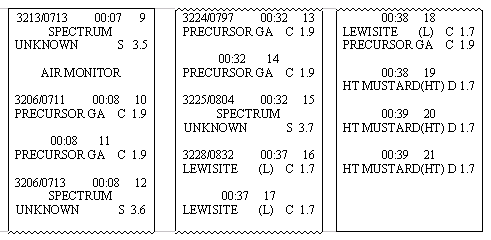 Figure 13. Fox tape, February 27, 1991
Approximately 30 minutes later, at 12:32 AM, the MM-1 alerted again for precursor GA. The operator immediately performed another spectrum, which again produced another "unknown" reading ruling out the presence of precursor GA. Minutes later, at 12:37 and 12:38 AM, the MM-1 alerted for lewisite and precursor GA at low intensities. The alerts for lewisite and precursor GA did not repeat, but the MM-1 alerted for HT mustard at 12:38 AM.
Analysis of Alert 7
These alerts occurred four hours after Alert 6. The complete tapes in Tab E show that between Alert 6 and 7 the sampling probe was not cleaned and was therefore susceptible to false alerts or alarms. The two spectra (12:07 and 12:08 AM) ruled out the presence of precursor GA, which is not a chemical warfare agent, but a chemical building block used to create tabun.[106] As described in the analysis section of Alert 1, UNSCOM and CIA assess that there were no deployed tabun-filled weapons.[107] At the time of the tabun alerts, the Fox vehicle was not under artillery attack, and Iraq did not fly ground attack sorties after January 25, 1991.[108] Since these were the only methods for tabun delivery, the Fox vehicle could not have detected tabun or precursor GA.
During its inspections, UNSCOM did not find any lewisite in Iraq’s inventory. Iraq had researched lewisite, but did not produce or weaponize it;[109] thus it was not present on the battlefield.
The "D" next to the HT mustard on the tape indicates that the MM-1 operator was running the temperature program to clean the MM-1 probe at the time of the HT mustard alerts. While the probe is being cleaned, significant ion activity occurs, so interferents can cause false alarms. After the temperature program finished, the MM-1 recorded no alerts for over three hours.[110]
There was also no alert for HD mustard, the more volatile component of HT—indicating a false alert. (See Alerts 3 and 5 above.) As noted in other alerts, Iraqi ground-attack aircraft did not fly after January 25, 1991; therefore, aerial bombs did not deliver the agents the Fox alerted for. The only means of ground system delivery for mustard agent was 155mm artillery, but during this alert, the Fox was not receiving any artillery fire. Finally, the ion intensity levels of all these alerts for precursor tabun, lewisite, and HT mustard were very low, making it even more unlikely that the alerts were true.[111] Based on the operational insights that the unit was not under attack, the absence of these agents in Iraq’s inventory, as well as the two spectra showing the absence of chemical warfare agents, this Fox vehicle did not detect any chemical warfare agents in this incident.
d. Alert 8: February 27, 1991, 3:57 AM
About three and a half hours later, at 3:57 and 3:58 AM, the MM-1 alerted for dimethylphthalate and diethyphthalate, both confidence-check simulants, while operating in the Test/Lo method (Figure 14). Approximately five hours later, at 9:33 and 9:34 AM, the MM-1 alerted for HT mustard. Between the alerts for the simulants and those for HT, the MM-1 operator switched from the Test/Lo to the Air/Hi method. The MM-1 operator performed a full spectrum a minute after the HT alert. The spectrum indicated the presence of FC 77, the calibration gas.
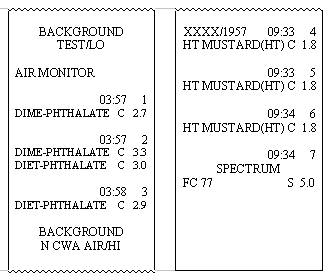 Figure 14. Fox tape, February 27, 1991
Analysis of Alert 8
Like Alert 4, the MM-1 alerted here for confidence check simulants while in the Test/Lo method, the only method in which the MM-1 monitors for confidence check simulants. When the method was changed to Air/Hi, a temperature program was not run after the confidence checks to clear the simulants. The confidence check simulants were therefore never cleaned from the probe, making it prone to false alerts or alarms.[112]
Once again, the ion intensity levels of these HT mustard alerts were very low, making it doubtful that the alerts were true based on this fact alone. Moreover, once again the MM-1 did not alert for HD mustard, the more volatile component of HT, indicating a false alert.[113] (See Alerts 3, 5, and 7 above.) It is now known that Iraq weaponized HD, not HT, though a trace amount of HT was contained in HD as a production byproduct.[114] Since Iraq didn’t attack, HT was not in the Iraqi inventory, and the spectrum indicated FC 77, HT mustard was not present; rather, simulants were still present in the probe.[115]