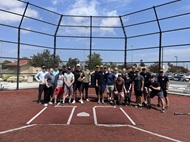
The radiology department baseball team wins the annual baseball tournament at NMCSD.
An official website of the United States government
Official websites use .mil
A .mil website belongs to an official U.S.
Department of Defense organization.
Secure .mil websites use HTTPS
A
lock (
) or https:// means you’ve safely connected to
the .mil website. Share sensitive information only on official,
secure websites.
Accessing Military Health Care During Lapse in Appropriations
The Military Health System will continue to provide health care during a government lapse in appropriations. There may be some effects on the delivery of health care services within military hospitals and clinics. Contact your hospital or clinic to confirm hours of operations and services provided.
Program Type: Residency program at a Military Medical Center
Location: San Diego, CA
Accredited: Accreditation Council for Graduate Medical Education (ACGME)
Program Length: 4 years
Required Pre-Requisite Training: Graduation from Medical School and Graduation from an ACGME-accredited PGY1 training program
Categorical Year in Specialty Required: No
Total Approved Complement: 28
Approved per Year (if applicable): variable
Dedicated Research Year Offered: No
Medical Student Rotation Availability: MS3s and MS4s
Additional Degree Concurrent with Training (e.g. MPH): No
The Naval Medical Center San Diego Diagnostic Radiology residency program is a four-year residency program, fully accredited by the ACGME. The mission of the program is to provide the highest quality medical care to the Navy community by developing and graduating broadly trained, clinically capable, board-eligible Diagnostic Radiologists who are prepared to serve in the diverse clinical environments of Navy Medicine.
The program consists of four years of radiology training under the mentorship of clinical experts with varied subspecialty backgrounds. Additionally, residents are afforded the opportunity to pursue clinical research and other academic interests in tandem with staff Radiologists.
Most of the clinical rotations are completed at Naval Medical Center San Diego, a premier military medical facility caring for a diverse patient base. These clinical experiences are supplemented with opportunities at other civilian institutions within the city. The broad training experience provides a case mix of appropriate complexity in the context of a supportive learning environment. Residents may also have opportunities to participate in global humanitarian medical experiences.
Our faculty is composed of both military and civilian Radiology experts with diverse specialty backgrounds. Faculty work in tandem with residents, allowing adequate time for teaching and mentoring, both with clinical work and with academic pursuits. Graduates of our residency proceed to a variety of renowned fellowship opportunities, positions at major academic centers, practice positions at a variety of military hospitals and are poised for a successful career in military and civilian Radiology.
The mission of the Naval Medical Center San Diego, Diagnostic Radiology residency program is to provide the highest quality medical care to the Navy community by developing and graduating broadly trained, clinically capable, board-eligible Diagnostic Radiologists who are prepared to serve in the diverse clinical environments of Navy Medicine. The mission of the residency aligns with the mission of NMCSD which is to prepare to deploy in support of operational commitments, deliver quality health services, and shape the future of military medicine through education, training, and research.
We are a premiere military radiology training program, producing physician leaders committed to clinical excellence, and driving quality improvement in health care; uniquely ready to lead and serve within the military and civilian health care systems.
To provide residents with comprehensive training in the full breadth of radiology and to produce graduates that are broadly experienced, capable diagnostic radiologists, and empathetic physicians committed to the best interests of the patient.
To graduate residents that possess the technical expertise and administrative competencies to thrive in the Navy/DOD environment including leading radiation health and safety programs, operating large clinical departments, and demonstrating expertise in personnel and resource management.
To provide for the personal and professional development of residents and faculty who are prepared to serve as health care leaders.
To develop physicians who encourage and lead continuous process evaluation and process improvement, with the ability to refine the methods of delivering safe, quality health care.
To promote clinical research and academic achievements that advance the practice of Radiology.
The Diagnostic Radiology residency has a well- defined academic curriculum which is cross referenced with the American Board of Radiology emphasis areas. This curriculum is reviewed annually for areas of improvement.
The core of the academic curriculum is centered around the noon conference series. The academic schedule is reviewed each year to ensure that there is a cohesive and relevant learning plan for the academic year. Conferences include:
ABR Core and Certifying Examination emphasis areas, resident led M/M conferences, call case review (at least twice monthly) and General Radiology conferences and a dedicated Physics curriculum.
Additional multidisciplinary conferences occur on a recurring basis throughout the month and are listed on the monthly conference schedule. It is the resident’s responsibility to attend all conferences.
The Diagnostic Radiology Residency is a balanced educational program which offers comprehensive experience with training in all techniques and modalities of Diagnostic Radiology. Rotations during residency include Abdominal Radiology, Breast Imaging, Chest Radiology, Interventional Radiology, Musculoskeletal Radiology, Neuroradiology, Nuclear Medicine & Molecular Imaging, Pediatric Radiology, and Ultrasound. Clinical rotations are based on a four-week block with 13 rotations scheduled each academic year.
Rotation locations are as follows:
Clinical rotation assignments are assigned prior to the start of the academic year and include 13 rotations per academic year. During the PGY-4 (R3) year, residents attend a four-week course given by the American Institute for Radiologic Pathology, a program of the American College of Radiology. The course fulfills the ACGME requirement for a Radiologic-Pathologic correlation course. The course provides a comprehensive review of radiologic imaging and details the radiologic presentation of a broad range of diseases and their pathological basis across all organ systems and imaging modalities. This course is fully funded. Residents are also provided a half day of protected academic time each week to pursue research and scholarly activity. This emphasis on academic achievement, under the direction of faculty mentors, continues to produce numerous invitations to national level meetings and an increased number of invited publications.
The curriculum is founded on several core rotations as detailed below. Each rotation has dedicated goals and objectives which provide guidance to residents and faculty in achieving proficiency in ACGME core competencies. Each academic year is divided into thirteen four-week rotations. Residency starts on July 1st of the academic year and concludes June 30, four years later.
Resident will complete the equivalent of 52 rotations.
Remembering the military’s unique need for broadly trained radiologists, no more than eight rotations will be allowed in any one area. The table below lists the minimum number of months a resident will be assigned to any rotation.
| Rotation Name | Minimum Number Rotations |
|---|---|
| Abdominal Imaging (GI/GU) | 4 |
| AIRP | 1 |
| Musculoskeletal | 5 |
| Chest | 4 |
| Emergency Radiology | 3 |
| Swing | 3 |
| Interventional Radiology | 2 |
| Breast Imaging | 3 |
| Night Float | 2 |
| Neuroradiology | 5 |
| Nuclear Medicine | 4 |
| Cardiac | 1 |
| Pediatrics | 4 |
| Ultrasound | 4 |
| Additional Rotations | 9 |
| Total Rotations Required | 52 |
The Diagnostic Radiology residency program has a well vetted resident clinical and call schedule which remains well within the 80-hour work week and accounts for adequate time off between clinical obligations.
Independent overnight call with predominantly indirect supervision allows for adequate teaching opportunity in the call environment. A period of indirect supervision is preserved to develop autonomy in decision making, invaluable training for independent practice.
The academic curriculum incorporates topics related to military professional development and the role of the radiologist within the Navy/Defense Health Agency. These lectures are presented by select faculty with emphasis on the experience as a radiologist in the diverse clinical roles within Navy Medicine. Presentations are included on deployed medicine opportunities. Professional and career development lectures are included as part of this curriculum.
All Diagnostic Radiology Residents are required to maintain certification in Basic Life Support (BLS) throughout their residency training.
A pre-call simulation experience is utilized as part of the comprehensive first year curriculum. The experience allows exposure to select imaging cases that are directly relevant to radiology call.
The leadership Curriculum is contained within the military unique curriculum.
The Diagnostic Radiology residency experience includes the opportunity to participate in dedicated academic or research activity under the direction of faculty mentors.
Quality improvement in Radiology is a continual, evolving process. Residents can participate in or lead department or hospital wide quality improvement efforts. Experiences include participation on the department Radiation Safety committee, CT Risk Management Committee, MRI Safety Committee, among others. Quality participation efforts are presented annually at the Naval Medical Center San Diego Quality Improvement Fair.
Professional Development is woven into the fabric of radiology residency. Professional development topics are included in the program didactics. Select opportunities are available to attend formal professional development courses offered by the Navy. Residents are also encouraged to participate in the command career development boards to enhance their career progress.
Medical Student rotation opportunities are available to all eligible students. A four-week rotation will generally include exposure to Abdominal Radiology, Breast Imaging, Chest Radiology, Musculoskeletal Radiology, Neuroradiology, Nuclear Medicine/Molecular Imaging and Ultrasound.
Please visit our Medical Student Rotation informational page to see a listing of available medical student rotations offered at NMCSD.
The interview is designed to assist the applicant is making an optimized decision on the choice of specialty and location of training. Interviews are conducted during the designated interview season, generally from July through mid-October. The closing date of interviews is delineated in the annual BUMED Note 1524. After scheduling the interview and prior to the interview date, the program administrator will request some preliminary information, please return them in a timely fashion, in preparation for the interview. On the day of the interview, the applicant will meet and interview with the chief resident(s). This is an informal opportunity to meet a resident in the program and hear about the program from their perspective. It is an invaluable opportunity to ask detailed questions about the program. Following this, the applicant will meet and interview with the program director or assistant program director. Interested applicants can email the Diagnostic Radiology Program to request an interview at: dha.san-diego.San-Diego-NMC.list.nmcsd-rads@health.mil
Successful graduates are eligible for board certification by the American Board of Radiology (ABOR). Additional information can be found on the ABOR website located at: https://www.theabr.org.
Residents participate in the learning process by preparing and delivering educational lectures for the noon conference series. Residents mentor medical students and interns as they rotate through the department. Finally, residents routinely present interesting cases at the local San Diego Radiological Society.
Residents are free to pursue other teaching opportunities available within the institution or within DHA as time permits.
There is broad subspecialty training represented among the teaching faculty, including Breast Imaging, Cardiothoracic imaging, Abdominal imaging, Musculoskeletal imaging, Neuroradiology, Nuclear Medicine, Interventional Radiology and Pediatric Radiology (Rady Children’s).
Formal and informal mentorship opportunities are available during training.
The program is a professional and collegial one with a cohort of residents and faculty who are dedicated to creating an optimized training environment. An annual resident retreat is held to discuss the program and strive for continual improvement. Residents also have a quarterly social meeting to enhance cohesion and camaraderie within the program. San Diego offers a host of outdoor opportunities for recreation, vital to maintaining balance during a busy residency.
Location: Radiology Department, Building 1, 2nd Floor (in the bridge/tunnel section)
Monday–Friday
8 a.m. to 4 p.m.
Phone: 619-532-6755
The appearance of hyperlinks does not constitute endorsement by the Department of Defense of non-U.S. Government sites or the information, products, or services contained therein. Although the Defense Health Agency may or may not use these sites as additional distribution channels for Department of Defense information, it does not exercise editorial control over all of the information that you may find at these locations. Such links are provided consistent with the stated purpose of this website.
You are leaving Health.mil View the external links disclaimer.