On Jan. 27, 1967, Army Spc. Four Donald Ward “Doc” Evans Jr. “dashed across 100 meters of open area through a withering hail of enemy fire and exploding grenades” to treat and drag wounded soldiers to safety until he died from multiple injuries, according to his Medal of Honor citation. For paying the ultimate sacrifice, Evans was the first Vietnam War medic to receive the medal posthumously. He was 23 and married.
Nearly 20 years later in 1986, Evans Army Community Hospital on Fort Carson, Colorado, honored his sacrifice and gave his name to the original Fort Carson hospital complex built in 1942. Today, EACH honors Evans’ memory by earning superior ratings for its patient- and family-centered healthcare services.
A young medic in Vietnam
Evans enlisted in the Army in 1965 after graduating high school in Covina, California, where he excelled as a cross-country runner. Evans completed his medic training with Company D, 1st Battalion, at the U.S. Army Medical Training Center on Fort Sam Houston, graduating in June 1966 and deploying shortly after.
Excerpts from Evans’ personal journal and photos, provided by the U.S. Army Medical Department, show the challenging conditions the young medic and his platoon faced while serving in Vietnam:
- Oct.14, 1966: “When the convoy was lined up, they gave us ammo. I carry morphine, so you know we’re here.”
- Nov. 11, 1966: “I’m sitting alongside a Pup tent that’s about as dry as dry during a rain as the ocean. We live half like animals and half like people. During the last 10 days, I’ve slept in the wet.”
- Dec. 10-22, 1966: “I got another metal [sic] for my collections. It’s a … Combat Medics Badge. You get it for being in a combat area for more than 30 days or being in hostile fire twice.”
Evans’ day of sacrifice
According to his Medal of Honor citation, during a firefight near the hamlet of Tri Tam, Binh Duong Province, Evans left his position of relative safety with his platoon to answer the calls for medical aid from the wounded men of another platoon which was heavily engaged with the enemy force. The hamlet was located north of the infamous and heavily occupied Iron Triangle.
After bringing the wounded to safety, Evans returned to the forward location to treat more casualties and was struck and seriously injured by hand grenade fragments. He continued to evacuate other wounded soldiers, was severely wounded again, and rejoined his platoon. The citation goes on: “Continuing to refuse medical attention and ignoring advice to remain behind, he managed with his waning strength to move yet another wounded comrade across the dangerous open area to safety.”
“Disregarding his painful wounds and seriously weakened from profuse bleeding, he continued his lifesaving medical aid and was killed while treating another wounded comrade,” according to his citation.
Thanks largely to Evans’ bravery in his rescue efforts that day while severely wounded, only three soldiers died in the firefight; Evans was one of them.
EACH quality honors ‘Doc’ Evans every day
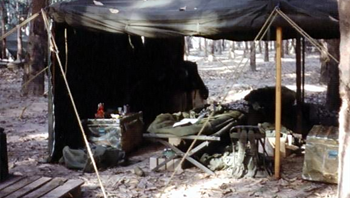 A typical Arctic Army-issued tent was usually used by four or five soldiers. Poorly suited for Vietnam’s extreme high temperatures, the tents sides were rolled up to allow some cooling. The tent was where Army Spc. Four Donald Ward Evans, Jr. bunked. He was the first medic in Vietnam to receive the Medal of Honor posthumously.
Evans Army Community Hospital’s commitment to keeping Evans’ memory alive has resulted in a significant number of quality awards, including:
- “A” Safety Grades for the last four years from the independent watchdog The Leapfrog Group. You can find ratings for keeping patients safe from errors, injuries, accidents, and infections for all military hospitals and clinics in the list of current quality, patient safety, and access information.
- A meritorious recognition from the American College of Surgeons’ National Surgical Quality Improvement Program. The NSQI is a variable-based data registry reflecting high standards in surgical care.
- A triennial survey by the certification body, The Joint Commission, in February 2025 recognized EACH for a staff culture of engagement in patient safety.
- A Greenhealth Partner for Change award in 2025 from the nation’s leading organization dedicated to environmental sustainability in health care.
The Fort Sam Houston Evans Auditorium on Joint Base San Antonio, Texas, honored Evans in June 1972. Many Army medics trained at JBSA receive their graduation certificates at the auditorium.
‘One of the good guys’
During the 1972 dedication, several of Evans’ combat buddies spoke about him. Al Peckham and Bill Comeau called Evans “one of the good guys,” according to ceremony materials in the U.S. Army Medical Department historical collection.
They noted: “These [photos] are the details that Don wanted you to know about, showing the exotic locale where he served so gallantly. Today many of the men ... survived their tour in Vietnam because of Donald's heroic deeds while administering to them that day in January 1967. They never forgot him.”
There were 58,200 Americans killed or missing in action in Vietnam. Like all of them, Evans’ name is engraved on the Vietnam Veterans Memorial in Washington, D.C. A letter left on the wall on May 28, 2023, from Dr. Gene A. Godwin reads: “I was the battalion surgeon when Donald was killed. His sacrifice will be remembered as will his wonderful personality and loyalty to his country. His sacrifice is not forgotten.”