Sharmila Chari, Ph.D., and U.S. Air Force Lt. Col. Dan Cassidy, Ph.D., ABPP
June 24, 2026
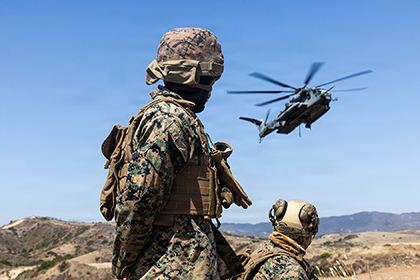
U.S. Marine Corps photo by Sgt. Mary TorresBLUF (Bottom Line Up Front): The dynamics of a Great Power Competition dictate that the next major conflict will look and feel different from what U.S. forces learned to expect from two decades of operations in Iraq and Afghanistan. Quick helicopter rescues? Probably not happening. That means you and your team are going to be the first responders for physical and mental health. That’s why the Defense Health Agency, in its capacity as a Combat Support Agency, is developing peer-support tools like iCOVER — a "crawl, walk, run" approach to mental training — and more to keep us in the high-end fight.
The new face of war: Welcome to LSCO
In recent decades, U.S. forces enjoyed air superiority — largely uncontested skies and the associated freedom to strike the enemy, circulate personnel, and rapidly transit medical and mental health emergencies to clinical hubs staffed by medics. But warfare is changing fast, and the operational landscape is already different in ways that matter immensely. Large-Scale Combat Operations will see us square-off against "near-peer" enemies whose equipment and technology more closely mirror ours2,7. In this kind of fight, communication lines will get jammed, evading enemy drones will be a full-time job, and we’ll need to manage the unexpected in place, with what resources we have at hand. To succeed, units will need to stay small and move fast2.
The hidden enemy: Combat Stress
When you are dodging artillery and constantly watching the skies, physical injuries aren't the only thing you have to worry about. The demands from fighting a high-tech enemy can boost Combat and Operational Stress5, and forces that manage COS effectively are far more likely to prevail in the moments that matter most.
Military medicine is actively building capabilities to support multi-domain operation in contested environments. Experts know that providing mental health support changes when the battlefield is everywhere — land, air, sea, space, and cyber — and communication is constantly cut off4. And when the air is contested and MEDEVAC isn’t always possible, every warfighter must be capable of delivering what’s referred to as “Prolonged Field Care,” supporting a battle buddy’s physical and mental health until the next echelon of support is available5.
The fix: You are a first responder
So, who handles combat stress when the experts aren’t accessible? Look at those around you, and know that they’re looking at you, too1.
The military is going all-in on training "buddy aid" for mental health1,3. You carry a physical tourniquet to stop bleeding, and you’ll now need a mental tourniquet to maintain combat effectiveness during COS. Initiatives like the Marine Corps' OSCAR program are teaching regular troops how to step in and save their squadmates during a mental crisis3.
One of the best-established ‘mental tourniquets’ is called iCOVER1. Adapted from the Israel Defense Forces, it’s a rapidly deployed, six-step hack to get a “frozen” teammate back in the fight1.
The iCOVER method: Your mental tourniquet
| Step |
Action |
How You Do It |
| 1 |
Identify |
Notice if your teammate is frozen, panicked, or totally zoning out. |
| 2 |
Connect |
Make eye contact, safely grab their gear, and get their attention. |
| 3 |
Offer Commitment |
Tell them straight up: "I am here with you, and we are going to get through this." |
| 4 |
Verify Facts |
Ask two or three super simple questions (like, "What is your last name?"). |
| 5 |
Establish Order |
Remind them what just happened and tell them exactly what is happening next. |
| 6 |
Request Action |
Give them a simple, direct job to do right now to get them moving again. |
The "crawl, walk, run" approach to mental grit
You don't just wake up one day knowing how to handle the stress of LSCO. The military is adopting a new "crawl, walk, run" approach to building psychological resilience6.
- Crawl: You learn basic mental skills (like breathing control and focus) in a controlled classroom setting.
- Walk: You practice those skills during routine field exercises.
- Run: You execute the skills in realistic combat simulations, exhausted and under fire. By gradually turning up the heat, you build the mental muscle memory to perform effectively in unpredictable and unforgiving operational settings6.
Support services: Build your armor now
Building mental resilience starts now. Every branch has tools to help you and your family:
- U.S. Army: Check out the Directorate of Prevention, Resilience and Readiness for training that toughens up your mind and body.
- U.S. Air Force: Programs like True North position mental health assets inside your squadron.
- U.S. Navy & Marine Corps: OSCAR trains Marines and Sailors to be peer mentors, basically making sure you always have a buddy who knows how to help.
- U.S. Space Force: The Space Force fields Guardian Resiliency Teams that put mental health providers and fitness coaches directly on base to keep Guardians sharp.
DOW-Wide lifelines
- Psychological Health Center of Excellence: The PHCoE features a wide range of resources relevant to all things military mental health.
- The Real Warriors Campaign connects directly with service members to promote help-seeking and adaptive problem-solving.
- Military OneSource: Free, 100% confidential counseling 24/7. Hit them up at MilitaryOneSource.mil or call 800-342-9647.
- Veterans Crisis Line: If things hit rock bottom, do not wait. Visit VeteransCrisisLine.net, dial 988 (then press 1), or text 838255.
- Chaplain Corps: No matter what branch you are in, Chaplains offer 100% confidential talk sessions, with or without a spiritual focus — your choice.
The bottom line
Tomorrow’s battlefield will test our formations’ readiness and resilience, but we’ve got the people and the tools to succeed. Time to get after it.
References
- Adler, A. B., & Bliese, P. D. (2021). iCOVER: A peer-to-peer training program for rapid acute stress intervention in combat. Psychological Services, 18(3), 324–332. https://doi.org/10.1037/ser0000412
- Department of the Army. (2022). Field manual 3-0: Operations. Headquarters, Department of the Army.
- Department of the Navy. (2021). Operational Stress Control and Readiness training manual. Headquarters, United States Marine Corps.
- Hoyt, T. (2025). Preparing mental health support for multi-domain, large-scale combat operations: Current progress and future directions. Military Medicine, 190(Supplement_2), 50-56. https://doi.org/10.1093/milmed/usaf083
- Hoyt, T., & Hein, C. L. (2021). Combat and operational stress control in the prolonged field care environment. Military Review, 101(5), 55-63.
- Nordstrand, A. E., Engen, H. G., & Adler, A. B. (2026). “Crawl, walk, run”: A graded approach to integrating mental skills for psychological resilience in training for large-scale combat operations. Military Psychology, 1–14. https://doi.org/10.1080/08995605.2026.2612680
- U.S. Army Training and Doctrine Command (TRADOC). (2018). The U.S. Army in multi-domain operations 2028 (TRADOC Pamphlet 525-3-1).
Sharmila Chari, Ph.D., is a clinical psychologist and contracted senior scientific advisor for the Psychological Health Center of Excellence. She has experience in psychological health research portfolio management, program development, conducting research and evaluation for serious mental illnesses and substance use disorders, equitable mental health care delivery, and trauma-informed programs.
U.S. Air Force Lt. Col. Dan Cassidy, Ph.D., ABPP, is a board-certified clinical health psychologist at the PHCoE with research and applied interests in population science and health behavior change.