Maggie Roth, LCSW, Philip R. Magaletta, Ph.D., Erin McNett, Psy.D., and Marie Manteuffel, PharmD, MPH, MADSS
April 21, 2026
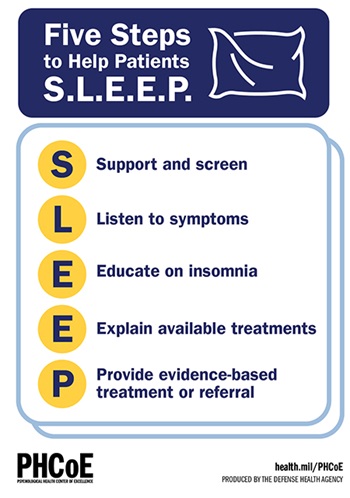
PHCoE graphic As a health care provider, you might often ask your patients, “How are you sleeping?” If they say, “not great,” they’re not alone. In fact, 48.6% of service members endorse poor sleep quality.1 This includes difficulty falling or staying asleep, or early morning wakings that affect daily life. If these symptoms happen regularly, they may meet diagnostic criteria for insomnia. Insomnia can lead to missing work, poor work performance, strained interpersonal relationships, and an overall decline in physical and mental health.2 Insomnia is important to assess and treat, especially in active duty service members. Sleeping well can boost job performance, strengthen warfighter readiness, and improve their quality of life.
Five Steps to Help Patients S.L.E.E.P.
Support and screen
In the clinical encounter, encourage conversation about sleep and reinforce taking steps to improve sleep health as a protective factor. You can normalize seeking care by sharing how common sleep problems are in the military—64% of service members reported that they only get 4-6 hours of sleep per day and only 9.2% of service members rated their sleep quality as “very good.”3 Screening sleep complaints by using validated instruments can also foster conversation about sleep habits.2 Results from the screening can help you and your patient determine next steps for treatment.
Listen to symptoms
Sleep complaints may also relate to psychological symptoms. Poor sleep in service members is associated with a higher risk of suicide and other mental health disorders such as posttraumatic stress disorder, anxiety, and depression.2 In addition to mood symptoms, sleep loss is also associated with physical symptoms or conditions that can impact military performance and personal safety, such as fatigue, cardiovascular disease, and changes in cognitive functioning.4 Refer to this provider’s guide for more information on when treatment for insomnia is appropriate and when treatment may need to be delayed or adapted, based on symptoms present.
Educate on insomnia
Although education alone is not treatment, empowering patients with knowledge on symptoms of insomnia and available resources is central to collaborative care.2 Due to the nature of military work, such as rotating schedules, shift work, deployments, and connection across time zones, service members may get six or fewer hours of sleep per night.1,4 Review how lack of sleep may be affecting their daily life, looking especially for changes in mood and social interactions, difficulty concentrating at work, increased mistakes or accidents while working, and daytime drowsiness, and provide reassurance that insomnia is treatable.1
Explain available treatments
Patients may not be aware of all treatment options. While Cognitive Behavioral Therapy for Insomnia (CBT-I) is the longest standing and best-established treatment for insomnia, Brief Behavioral Therapy for Insomnia (BBT-I) also is an effective treatment.2 Medication options may be discussed in conjunction with psychotherapy. However, evidence for medication is weaker than that for CBT-I, and there’s the potential for medication to impact job duties.2 You can review different treatments here and discuss with patients their specific needs and preferences, such as method of delivering therapy and time commitment. Depending on your patient’s job duties and work setting, other interventions may be helpful. Strategies suggested in this health promotion DODI highlight ways to improve sleep health—like using mobile apps to track sleep or work hours, or using a mobile app to establish a calming bedtime routine, or reviewing environmental factors that impact sleep quality.5
Provide evidence-based treatment or referral
Based on your training and skill set, along with your patient’s needs, you may decide to move forward with CBT-I or BBT-I. If you’re not trained in these modalities, this will require referral to another provider. The goal is to equip your patient with skills that improve their sleep and readiness, and performance.
Walk through these five steps together with your patient to identify what actions are applicable to improvement of their sleep. And let’s not forget—as a healthcare provider, it’s also important to ask yourself how you’re sleeping. These same steps may help you sleep, feel, and perform better.
Insomnia treatment is effective and available. So, skip the snooze button on these five steps for promoting sleep health.
References
- Troxel, W.M., Shih, R.A., Pedersen, E.R., Geyer, L., Fisher, M.P., Griffin, B.A., Haas, A.C., Kurz, J., & Steinberg, P.S. (2015). Sleep in the military: Promoting healthy sleep among U.S. servicemembers. RAND Health Quarterly, 5(2),19. https://www.rand.org/pubs/research_reports/RR739.html
- Veterans Affairs and Department of Defense. (2025). VA/DOD Clinical Practice Guideline for the Management of Chronic Insomnia Disorder and Obstructive Sleep Apnea. Version 3.0. https://www.healthquality.va.gov/HEALTHQUALITY/guidelines/CD/insomnia/I-OSA-CPG_2025-Guideline_final_20250915.pdf
- Meadows, S.O., Engel, C.C., Collins, R.L., Beckman, R.L., Breslau, J., Bloom, E.L., Dunbar, M.S., Gilbert, M., Grant, D., Dawson, J.H., Holliday, S.B., MacCarthy, S., Pedersen, E.R., Robbins, M.W., Rose, A.J., Ryan, J.L., Schell, T.L., & Simmons, M.M. (2021). 2018 Department of Defense Health Related Behaviors Survey (HRBS): Results for the Active Component. RAND Corporation. https://www.rand.org/pubs/research_reports/RR4222.html.
- Good, C.H., Brager, A. J., Capaldi, V.F., & Mysliwiec, V. (2020). Sleep in the United States Military. Neuropsychopharmacology, 45(1), 176–191. https://doi.org/10.1038/s41386-019-0431-5
- Department of Defense. (2022, May 16). Health Promotion and Disease Prevention. (DOD Instruction 1010.10). https://www.esd.whs.mil/Portals/54/Documents/DD/issuances/dodi/101010p.PDF?ver=2018-01-12-113645-193
Maggie Roth, LCSW is a licensed clinical social worker and contractor supporting the Psychological Health Center of Excellence. Her professional interests include forensic social work and the impact of social determinants of health on behavior.
Philip Magaletta, Ph.D., is a clinical psychologist and contractor supporting the Psychological Health Center of Excellence. He conducts psychological research, training and administration in public health and safety systems and has professional interests in 12-step approaches to change, psychotherapy and workforce development.
Erin McNett, Psy.D. is a clinical psychologist and contractor supporting the Psychological Health Center of Excellence. Her professional interests include the assessment and treatment of mental health problems and the intersection of psychology and the law.
Marie Manteuffel, PharmD, MPH, MADSS, is chief of the Research Adoption branch of DHA’s Psychological Health Center of Excellence in Silver Spring, Md., where she leads efforts to advance the implementation of evidence-based practices.